


Với kết nối không dây trở thành tiêu chuẩn, Công nghệ mô-đun Bluetooth từ lâu đã được tích hợp vào mọi ngóc ngách trong cuộc sống của chúng ta. Cho dù đó là nghe nhạc, chuyển tập tin, điều khiển các thiết bị nhà thông minh, hoặc đồng bộ hóa dữ liệu với các thiết bị đeo được, Mô-đun Bluetooth là không thể thiếu. Tuy nhiên, nhiều nhà phát triển và quản lý sản phẩm thường cảm thấy bối rối khi lựa chọn giữa Bluetooth cổ điển Và Bluetooth năng lượng thấp (BLE) mô-đun—sự khác biệt giữa chúng là gì? Ưu điểm và nhược điểm tương ứng của chúng là gì?
Bài viết này sẽ cung cấp một phân tích chuyên sâu từ nhiều khía cạnh, bao gồm kiến trúc kỹ thuật, điện năng tiêu thụ, cơ chế kết nối, và kịch bản ứng dụng, để giúp bạn tìm ra giải pháp kết nối không dây phù hợp nhất cho nhu cầu sản phẩm của mình.
TÔI. Mô-đun Bluetooth cổ điển: Sinh ra cho tốc độ và dung lượng dữ liệu
1. Technical Architecture of Classic Bluetooth
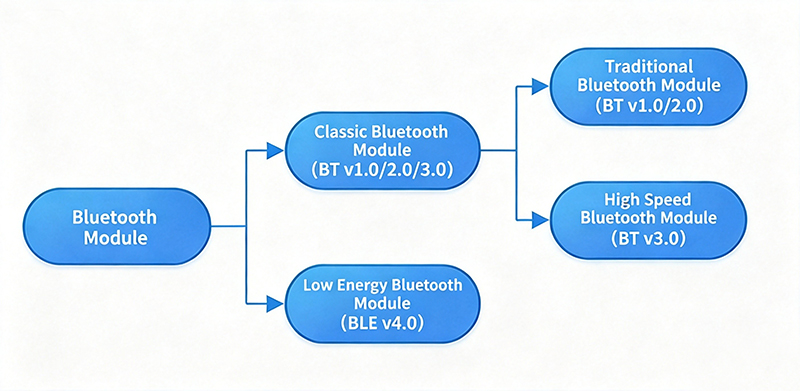
Classic Bluetooth modules refer to modules that support Bluetooth protocol versions below 4.0 (including 1.0, 1.2, EDR 2.0, EDR 2.1, EDR 3.0, vân vân.). Its core design philosophy revolves around “high throughput”—achieving continuous, high-speed data transmission by establishing a stable point-to-point (P2P) connection channel. Classic Bluetooth modules can be further divided into two main categories: traditional Bluetooth modules and high-speed Bluetooth modules. The former focuses on basic data exchange, while the latter leverages the 802.11 Wi-Fi physical layer to achieve higher transmission rates.
When we use wireless headphones to listen to high-quality music, share videos between phones via Bluetooth, or connect Bluetooth keyboards and mice for work, Classic Bluetooth is silently supporting us. It acts like a wide highway, capable of carrying continuous and stable data streams.
2. Core Advantages and Typical Applications of Classic Bluetooth
High Data Transmission Rate: Classic Bluetooth supports data transmission rates up to 3 Mb/giây, easily handling the real-time transmission needs of large amounts of data.
Wide Compatibility: As a mature technology, Classic Bluetooth boasts extremely high compatibility with billions of devices, including mobile phones, computers, and in-vehicle systems, ensuring stable connections between new and old devices.
Stable and Continuous Connection: Classic Bluetooth excels at establishing and maintaining continuous and reliable connections, which is crucial for applications requiring uninterrupted data flow (such as calls and music playback).
Higher Transmit Power: So với Bluetooth năng lượng thấp (BLE), Classic Bluetooth offers higher output power, helping to maintain signal strength and connection stability in specific environments.
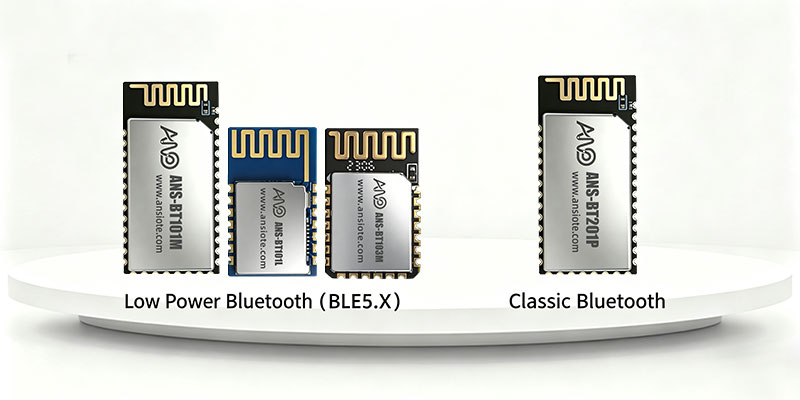
Taking the ANS-BT201P Classic Bluetooth module from Ansiot Technology as an example, this module supports SPP 2.0/3.0 protocols, features a master-slave integrated design, and has serial port pass-through and automatic pairing and reconnection functions. It can maintain reliable operation in scenarios with extremely high requirements for connection stability, such as industrial control and automotive equipment.
II. Bluetooth Low Energy Modules: Fighting for Energy Efficiency and Instant Connectivity
1. BLE Technology Evolution Roadmap
Bluetooth năng lượng thấp (BLE) mô-đun refer to modules that support Bluetooth protocol version 4.0 hoặc cao hơn, covering Bluetooth 4.0, 4.1, 4.2, and the next-generation Bluetooth 5.0, 5.1, 5.2, 5.3, and even 5.4 standards. Unlike the “persistent connection” approach of classic Bluetooth, BLE has focused on low power consumption and fast interaction from its inception. Its core concept is to reduce power consumption by significantly shortening the active time of the radio frequency, allowing devices to operate for months or even years on a single coin cell battery.
With each version iteration, BLE’s transmission rate, communication range, and broadcast data carrying capacity have continuously improved—Bluetooth 5.0 extended the transmission range to a theoretical 300 meters, and Bluetooth 5.2 introduced LE Audio and the LC3 codec, further expanding the market space for low-power audio.
2. BLE’s Core Advantages and Typical Applications
Bluetooth Low Energy acts like an extremely frugal butler, maximizing power saving. It is optimized for intermittent, low-data-volume transmission scenarios, chỉ tiêu thụ một phần mười hoặc thậm chí một phần trăm sức mạnh của Bluetooth cổ điển, đồng thời duy trì tốc độ thiết lập kết nối ở mức mili giây và hỗ trợ truyền dữ liệu một chiều ở chế độ phát sóng, đơn giản hóa đáng kể trải nghiệm tương tác và ghép nối thiết bị. Những đặc điểm này khiến BLE trở thành nền tảng kết nối trong kỷ nguyên IoT, bao phủ rộng rãi nhiều lĩnh vực như cảm biến nhà thông minh, thiết bị sức khỏe đeo được, đèn hiệu định vị trong nhà, thẻ giá điện tử, ổ khóa cửa thông minh, và điều khiển trung tâm thông minh cho xe điện.
Công nghệ tín dụng ANS-BT101M Và Mô-đun Bluetooth năng lượng thấp ANS-BT103L được thiết kế dựa trên khái niệm công nghệ này. ANS-BT101M sử dụng Bluetooth 5.1 giao thức, hỗ trợ truyền qua cổng nối tiếp và kết nối lại tự động HID, and is suitable for scenarios such as smart door locks that require both real-time response and low power consumption. The ANS-BT103L is based on the latest Bluetooth 5.4 standard, achieving stable slave-end serial port pass-through at ultra-low cost, making it an ideal choice for lightweight IoT devices.
III. Classic Bluetooth vs. Bluetooth năng lượng thấp: A Summary of Core Differences
To more intuitively present the differences between the two, the following comparison is based on key technical dimensions:
Deep Differences in Connection Mechanisms
Besides the obvious parameter differences in the table above, the difference in connection mechanisms is often a key factor underestimated by developers. Classic Bluetooth requires both parties to continuously maintain an active connection session. This means that even without data transmission, the link remains synchronized, continuously consuming power. BLE, Tuy nhiên, introduces a “broadcast-scan” model—the slave device can periodically send data packets on three broadcast channels, and the master device discovers and receives them by scanning. This method not only saves power but also supports one-to-many star topologies, making it possible for a single phone to connect to multiple BLE peripherals simultaneously. Hơn nữa, the BLE connection interval can be adjusted from 7.5 milliseconds to 4 seconds, allowing developers to flexibly optimize the balance between power consumption and latency based on actual data transmission frequency.
IV. How to Precisely Select Based on Application Scenarios?
1. Typical Scenarios for Selecting Classic Bluetooth Modules
If your product meets any of the following characteristics, you should prioritize classic Bluetooth modules:
High-capacity data transmission — Requires the transfer of large amounts of data between devices
Traditional peripheral compatibility — Requires connection to traditional peripherals such as Bluetooth keyboards and printers
Power insensitivity — Application scenarios are not sensitive to power consumption (ví dụ., automotive devices, desktop devices)
Existing device compatibility — Requires compatibility with a large number of existing classic Bluetooth devices
Recommended product: ANS-BT201P — SPP 2.0/3.0 classic Bluetooth module, master-slave integrated, serial port pass-through, automatic pairing and reconnection, stable and reliable.
2. Typical Scenarios for Choosing a Bluetooth Low Energy Module
If your product has the following characteristics, a Bluetooth Low Energy module would be a better solution:
Battery-powered, battery-sensitive — Powered by a coin cell or small lithium battery, extremely sensitive to battery life.
Intermittent small data packets — Only requires intermittent transmission of small data packets (such as temperature, humidity, location beacons).
IoT ecosystem — Belongs to the IoT, wearable device, or smart home ecosystem.
Low latency experience — Requires a low-latency experience with fast wake-up and instant connection.
Multi-device management — Desires to support simultaneous management of multiple Bluetooth peripherals via a mobile app.
Recommended products: ANS-BT101M (Bluetooth 5.1, serial port pass-through), ANS-BT103L (Bluetooth 5.4, low-cost slave pass-through).
3. Bluetooth chế độ kép: A hybrid solution that balances both.
It is worth noting that as Bluetooth technology continues to evolve, the boundary between Classic and Bluetooth Low Energy is gradually blurring. A large number of Bluetooth modules supporting dual-mode operation have emerged on the market. These modules can run both Classic Bluetooth and BLE protocol stacks on the same chip, eliminating the need for developers to choose between the two technologies.
Ví dụ, a smart headset can transmit high-quality music via Classic Bluetooth while simultaneously using the BLE channel to synchronize battery information and perform firmware upgrades with a mobile app. For product managers, if budget and development resources permit, dual-mode Bluetooth modules are often a safe and future-proof choice.
V.. Recommended Bluetooth Modules from Ansiot Technology
Ansiot Technology has deep expertise in the Bluetooth wireless communication field and has developed a complete product matrix covering Classic Bluetooth and Bluetooth Low Energy, meeting diverse needs from industrial control to consumer electronics. Here are our key recommended products:
ANS-BT201P — Classic Bluetooth Module
SPP 2.0/3.0 Giao thức | Master/Slave Integration | Serial Transparent Transmission | Automatic Pairing and Reconnection | Suitable for Industrial Control and Automotive Equipment
ANS-BT101M — Bluetooth Low Energy Module
Bluetooth 5.1 Giao thức | Master/Slave Integration | Serial Transparent Transmission + GIẤU | Suitable for Smart Locks and Wearable Devices
ANS-BT103L — Bluetooth Low Energy Module
Bluetooth 5.4 Latest Standard | Slave-End Serial Transparent Transmission | Ultra-Low Cost | Suitable for Lightweight IoT Devices
ANS-BT103S — Dual-Mode Bluetooth Module (Coming Soon)
Simultaneously supports Classic Bluetooth + BLE | Master/Slave Integration
VI. Câu hỏi thường gặp
Question 1: Can Classic Bluetooth and Bluetooth Low Energy interconnect?
KHÔNG, they cannot interconnect directly. Classic Bluetooth and BLE use different physical layers and protocol stacks. Interoperability requires a dual-mode Bluetooth device as a bridge. Dual-mode devices (such as most smartphones) can communicate simultaneously with both classic Bluetooth headsets and BLE smart bracelets, making them ideal intermediaries.
Question 2: Does Bluetooth 5.0 and above still differentiate between classic and low-power?
Đúng, Bluetooth 5.0 and above still retain two independent technical routes: classic Bluetooth and BLE module, but they share some underlying resources. In actual products, Bluetooth 5.0+ chips typically integrate both modes, allowing developers to choose between single-mode or dual-mode solutions based on their needs.
Question 3: Does the BLE module support audio transmission?
Traditionally, BLE did not support the A2DP audio protocol of classic Bluetooth, but with the introduction of LE Audio (based on the LC3 codec) in Bluetooth 5.2, low-power audio transmission has become a reality. LE Audio not only consumes less power but also supports new features such as Auracast broadcast audio, and is gradually becoming an important standard for next-generation wireless audio.
Question 4: How to evaluate whether the transmission distance of a Bluetooth module meets the requirements?
Transmission distance is affected by multiple factors, including transmit power, receiver sensitivity, thiết kế ăng-ten, and environmental obstacles. BLE theoretically boasts a range of up to 300 meters (in open environments) with Bluetooth 5.0 and later, but in practical applications, it’s recommended to rely on actual product test data. Ansiot Technology offers comprehensive Bluetooth module selection support and can assist in evaluation based on specific application scenarios.
VII. Bản tóm tắt
Classic Bluetooth modules and Bluetooth Low Energy modules are not opposing forces, but rather complementary technologies that excel in different scenarios. Bluetooth cổ điển, with its stable high throughput, remains indispensable in the field of wireless audio and data transmission; while Bluetooth Low Energy, with its exceptional energy efficiency and flexible topology, has become the preferred protocol for connecting everything in the Internet of Things era.
With the continued evolution of Bluetooth 5.0 and subsequent technologies, dual-mode fusion solutions are blurring the lines between the two, giving developers greater flexibility in selection. Tuy nhiên, regardless, a deep understanding of the technical essence and applicable boundaries of both remains the first lesson in designing excellent products and building reliable wireless connectivity solutions.
Core Selection Principles Review
Consider Data Volume — Choose Classic Bluetooth for large files/continuous streaming, and BLE for small packets/intermittent transmissions.
Consider Power Consumption — Prioritize BLE for battery-powered and battery-sensitive devices.
Consider Scenario — Classic Bluetooth is preferred for audio/traditional peripherals, while BLE is preferred for IoT/sensors.
Consider Compatibility — Choose the corresponding protocol version when compatibility with existing devices is required.
Consider Long-Term Vision — When budget allows, dual-mode modules are a safe and future-proof solution.
In this era of the Internet of Things, whether choosing the data-fast Classic Bluetooth or the energy-efficient BLE, understanding the underlying principles is crucial to maximizing its effectiveness. Your product deserves the most suitable wireless partner.