


With wireless connectivity becoming standard, Bluetooth module technology has long been integrated into every corner of our lives. Whether it’s listening to music, transferring files, controlling smart home devices, or synchronizing data with wearable devices, Bluetooth modules are indispensable. Fakat, many developers and product managers often find themselves confused when choosing between Klasik Bluetooth Ve Bluetooth Düşük Enerji (BLE) modüller—what are the differences between them? What are their respective advantages and disadvantages?
This article will provide an in-depth analysis from multiple dimensions, including technical architecture, güç tüketimi, connection mechanisms, ve uygulama senaryoları, to help you find the most suitable wireless connectivity solution for your product needs.
BEN. Classic Bluetooth Modules: Born for Speed and Data Capacity
1. Technical Architecture of Classic Bluetooth
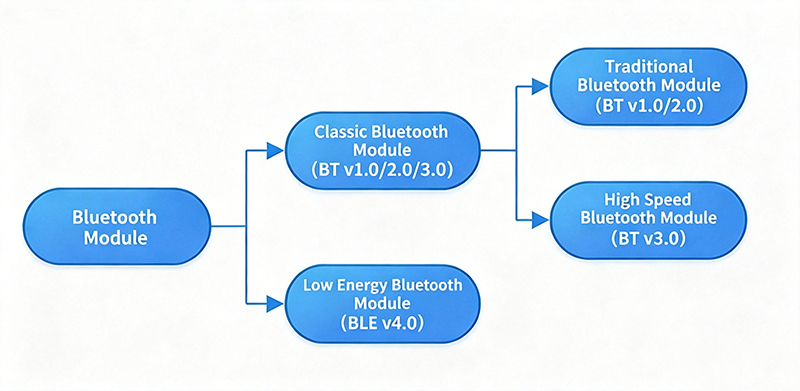
Classic Bluetooth modules refer to modules that support Bluetooth protocol versions below 4.0 (including 1.0, 1.2, EDR 2.0, EDR 2.1, EDR 3.0, vesaire.). Its core design philosophy revolves around “high throughput”—achieving continuous, high-speed data transmission by establishing a stable point-to-point (P2P) connection channel. Classic Bluetooth modules can be further divided into two main categories: traditional Bluetooth modules and high-speed Bluetooth modules. The former focuses on basic data exchange, while the latter leverages the 802.11 Wi-Fi physical layer to achieve higher transmission rates.
When we use wireless headphones to listen to high-quality music, share videos between phones via Bluetooth, or connect Bluetooth keyboards and mice for work, Classic Bluetooth is silently supporting us. It acts like a wide highway, capable of carrying continuous and stable data streams.
2. Core Advantages and Typical Applications of Classic Bluetooth
High Data Transmission Rate: Classic Bluetooth supports data transmission rates up to 3 Mbps, easily handling the real-time transmission needs of large amounts of data.
Wide Compatibility: As a mature technology, Classic Bluetooth boasts extremely high compatibility with billions of devices, including mobile phones, computers, and in-vehicle systems, ensuring stable connections between new and old devices.
Stable and Continuous Connection: Classic Bluetooth excels at establishing and maintaining continuous and reliable connections, which is crucial for applications requiring uninterrupted data flow (such as calls and music playback).
Higher Transmit Power: Compared to Bluetooth Düşük Enerji (BLE), Classic Bluetooth offers higher output power, helping to maintain signal strength and connection stability in specific environments.
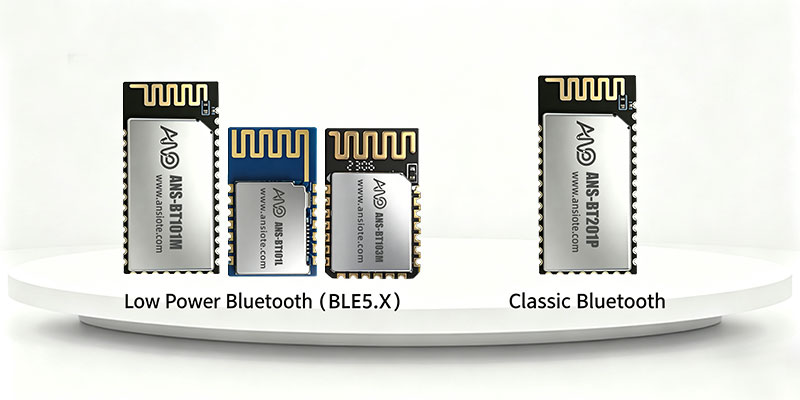
Taking the ANS-BT201P Classic Bluetooth module from Ansiot Technology as an example, this module supports SPP 2.0/3.0 protocols, features a master-slave integrated design, and has serial port pass-through and automatic pairing and reconnection functions. It can maintain reliable operation in scenarios with extremely high requirements for connection stability, such as industrial control and automotive equipment.
II. Bluetooth Low Energy Modules: Fighting for Energy Efficiency and Instant Connectivity
1. BLE Technology Evolution Roadmap
Bluetooth Düşük Enerji (BLE) modüller refer to modules that support Bluetooth protocol version 4.0 or higher, covering Bluetooth 4.0, 4.1, 4.2, and the next-generation Bluetooth 5.0, 5.1, 5.2, 5.3, and even 5.4 standards. Unlike the “persistent connection” approach of classic Bluetooth, BLE has focused on low power consumption and fast interaction from its inception. Its core concept is to reduce power consumption by significantly shortening the active time of the radio frequency, allowing devices to operate for months or even years on a single coin cell battery.
With each version iteration, BLE’s transmission rate, communication range, and broadcast data carrying capacity have continuously improved—Bluetooth 5.0 extended the transmission range to a theoretical 300 metre, and Bluetooth 5.2 introduced LE Audio and the LC3 codec, further expanding the market space for low-power audio.
2. BLE’s Core Advantages and Typical Applications
Bluetooth Low Energy acts like an extremely frugal butler, maximizing power saving. It is optimized for intermittent, low-data-volume transmission scenarios, klasik Bluetooth'un gücünün yalnızca onda biri, hatta yüzde biri kadar tüketiyor, Milisaniye seviyesinde bağlantı kurma hızlarını korurken ve yayın modunda tek yönlü veri aktarımını desteklerken, cihaz eşleştirme ve etkileşim deneyimini büyük ölçüde basitleştiriyor. Bu özellikler BLE'yi IoT çağında bağlantının temel taşı haline getiriyor, akıllı ev sensörleri gibi çok sayıda alanı geniş çapta kapsıyor, giyilebilir sağlık cihazları, iç mekan konumlandırma işaretleri, elektronik fiyat etiketleri, akıllı kapı kilitleri, ve elektrikli araçlar için akıllı merkezi kontrol.
Kredi Teknolojisi ANS-BT101M Ve ANS-BT103L Bluetooth Düşük Enerji modülleri bu teknolojik konsepte göre tasarlanmıştır. ANS-BT101M Bluetooth'u kullanır 5.1 protokol, seri port geçişini ve HID otomatik yeniden bağlanmayı destekler, hem gerçek zamanlı yanıt hem de düşük güç tüketimi gerektiren akıllı kapı kilitleri gibi senaryolara uygundur. ANS-BT103L en son Bluetooth teknolojisini temel alır 5.4 standart, Ultra düşük maliyetle istikrarlı yardımcı uç seri bağlantı noktası geçişi elde etme, hafif IoT cihazları için ideal bir seçimdir.
III. Klasik Bluetooth vs. Bluetooth Düşük Enerji: Temel Farklılıkların Özeti
İkisi arasındaki farkları daha sezgisel olarak sunmak için, aşağıdaki karşılaştırma temel teknik boyutlara dayanmaktadır:
Bağlantı Mekanizmalarındaki Derin Farklılıklar
Yukarıdaki tabloda bariz parametre farklılıklarının yanı sıra, bağlantı mekanizmalarındaki farklılık genellikle geliştiriciler tarafından hafife alınan önemli bir faktördür. Klasik Bluetooth, her iki tarafın da sürekli olarak aktif bir bağlantı oturumu sürdürmesini gerektirir. Bu, veri aktarımı olmasa bile, the link remains synchronized, continuously consuming power. BLE, however, introduces a “broadcast-scan” model—the slave device can periodically send data packets on three broadcast channels, and the master device discovers and receives them by scanning. This method not only saves power but also supports one-to-many star topologies, making it possible for a single phone to connect to multiple BLE peripherals simultaneously. Üstelik, the BLE connection interval can be adjusted from 7.5 milliseconds to 4 saniye, allowing developers to flexibly optimize the balance between power consumption and latency based on actual data transmission frequency.
IV. How to Precisely Select Based on Application Scenarios?
1. Typical Scenarios for Selecting Classic Bluetooth Modules
If your product meets any of the following characteristics, you should prioritize classic Bluetooth modules:
High-capacity data transmission — Requires the transfer of large amounts of data between devices
Traditional peripheral compatibility — Requires connection to traditional peripherals such as Bluetooth keyboards and printers
Power insensitivity — Application scenarios are not sensitive to power consumption (örneğin, automotive devices, desktop devices)
Existing device compatibility — Requires compatibility with a large number of existing classic Bluetooth devices
Recommended product: ANS-BT201P — SPP 2.0/3.0 classic Bluetooth module, master-slave integrated, seri port geçişi, automatic pairing and reconnection, stable and reliable.
2. Typical Scenarios for Choosing a Bluetooth Low Energy Module
If your product has the following characteristics, a Bluetooth Low Energy module would be a better solution:
Battery-powered, battery-sensitive — Powered by a coin cell or small lithium battery, extremely sensitive to battery life.
Intermittent small data packets — Only requires intermittent transmission of small data packets (such as temperature, humidity, location beacons).
IoT ecosystem — Belongs to the IoT, wearable device, or smart home ecosystem.
Low latency experience — Requires a low-latency experience with fast wake-up and instant connection.
Multi-device management — Desires to support simultaneous management of multiple Bluetooth peripherals via a mobile app.
Recommended products: ANS-BT101M (Bluetooth 5.1, seri port geçişi), ANS-BT103L (Bluetooth 5.4, low-cost slave pass-through).
3. Çift modlu Bluetooth: A hybrid solution that balances both.
It is worth noting that as Bluetooth technology continues to evolve, the boundary between Classic and Bluetooth Low Energy is gradually blurring. A large number of Bluetooth modules supporting dual-mode operation have emerged on the market. These modules can run both Classic Bluetooth and BLE protocol stacks on the same chip, eliminating the need for developers to choose between the two technologies.
Örneğin, a smart headset can transmit high-quality music via Classic Bluetooth while simultaneously using the BLE channel to synchronize battery information and perform firmware upgrades with a mobile app. For product managers, if budget and development resources permit, dual-mode Bluetooth modules are often a safe and future-proof choice.
V. Recommended Bluetooth Modules from Ansiot Technology
Ansiot Technology has deep expertise in the Bluetooth wireless communication field and has developed a complete product matrix covering Classic Bluetooth and Bluetooth Low Energy, meeting diverse needs from industrial control to consumer electronics. Here are our key recommended products:
ANS-BT201P — Classic Bluetooth Module
GES 2.0/3.0 Protokol | Master/Slave Integration | Serial Transparent Transmission | Automatic Pairing and Reconnection | Suitable for Industrial Control and Automotive Equipment
ANS-BT101M — Bluetooth Low Energy Module
Bluetooth 5.1 Protokol | Master/Slave Integration | Serial Transparent Transmission + HID | Suitable for Smart Locks and Wearable Devices
ANS-BT103L — Bluetooth Low Energy Module
Bluetooth 5.4 Latest Standard | Slave-End Serial Transparent Transmission | Ultra-Low Cost | Suitable for Lightweight IoT Devices
ANS-BT103S — Dual-Mode Bluetooth Module (Coming Soon)
Simultaneously supports Classic Bluetooth + BLE | Master/Slave Integration
VI. SSS
Question 1: Can Classic Bluetooth and Bluetooth Low Energy interconnect?
HAYIR, they cannot interconnect directly. Classic Bluetooth and BLE use different physical layers and protocol stacks. Interoperability requires a dual-mode Bluetooth device as a bridge. Dual-mode devices (such as most smartphones) can communicate simultaneously with both classic Bluetooth headsets and BLE smart bracelets, making them ideal intermediaries.
Question 2: Does Bluetooth 5.0 and above still differentiate between classic and low-power?
Evet, Bluetooth 5.0 and above still retain two independent technical routes: classic Bluetooth and BLE module, but they share some underlying resources. In actual products, Bluetooth 5.0+ chips typically integrate both modes, allowing developers to choose between single-mode or dual-mode solutions based on their needs.
Question 3: Does the BLE module support audio transmission?
Traditionally, BLE did not support the A2DP audio protocol of classic Bluetooth, but with the introduction of LE Audio (based on the LC3 codec) in Bluetooth 5.2, low-power audio transmission has become a reality. LE Audio not only consumes less power but also supports new features such as Auracast broadcast audio, and is gradually becoming an important standard for next-generation wireless audio.
Question 4: How to evaluate whether the transmission distance of a Bluetooth module meets the requirements?
Transmission distance is affected by multiple factors, including transmit power, receiver sensitivity, anten tasarımı, and environmental obstacles. BLE theoretically boasts a range of up to 300 metre (in open environments) with Bluetooth 5.0 and later, but in practical applications, it’s recommended to rely on actual product test data. Ansiot Technology offers comprehensive Bluetooth module selection support and can assist in evaluation based on specific application scenarios.
VII. Özet
Classic Bluetooth modules and Bluetooth Low Energy modules are not opposing forces, but rather complementary technologies that excel in different scenarios. Klasik Bluetooth, with its stable high throughput, remains indispensable in the field of wireless audio and data transmission; while Bluetooth Low Energy, with its exceptional energy efficiency and flexible topology, has become the preferred protocol for connecting everything in the Internet of Things era.
With the continued evolution of Bluetooth 5.0 and subsequent technologies, dual-mode fusion solutions are blurring the lines between the two, giving developers greater flexibility in selection. Fakat, regardless, a deep understanding of the technical essence and applicable boundaries of both remains the first lesson in designing excellent products and building reliable wireless connectivity solutions.
Core Selection Principles Review
Consider Data Volume — Choose Classic Bluetooth for large files/continuous streaming, and BLE for small packets/intermittent transmissions.
Consider Power Consumption — Prioritize BLE for battery-powered and battery-sensitive devices.
Consider Scenario — Classic Bluetooth is preferred for audio/traditional peripherals, while BLE is preferred for IoT/sensors.
Consider Compatibility — Choose the corresponding protocol version when compatibility with existing devices is required.
Consider Long-Term Vision — When budget allows, dual-mode modules are a safe and future-proof solution.
In this era of the Internet of Things, whether choosing the data-fast Classic Bluetooth or the energy-efficient BLE, understanding the underlying principles is crucial to maximizing its effectiveness. Your product deserves the most suitable wireless partner.