
Trong thời đại tăng trưởng bùng nổ về số lượng thiết bị IoT ngày nay, Bluetooth năng lượng thấp (BLE) mô-đun đã trở thành một liên kết cốt lõi kết nối thế giới vật lý và kỹ thuật số. Từ thiết bị đeo thông minh và giám sát y tế đến cảm biến công nghiệp, mô-đun BLE, với mức tiêu thụ điện năng cực thấp và khả năng tương thích hệ sinh thái rộng, chiếm vị trí thống trị trong truyền thông không dây tầm ngắn.
Nếu bạn đang bối rối trong việc lựa chọn sản phẩm hoặc muốn đi sâu vào cốt lõi kỹ thuật của mô-đun Bluetooth Low Energy, phân tích toàn diện này sẽ làm sáng tỏ sự nhầm lẫn của bạn. Bài viết này cung cấp một cái nhìn tổng quan đầy đủ từ năm chiều: nguyên tắc cốt lõi, lợi thế kỹ thuật, thông số chính, kịch bản ứng dụng, và mẹo lựa chọn.
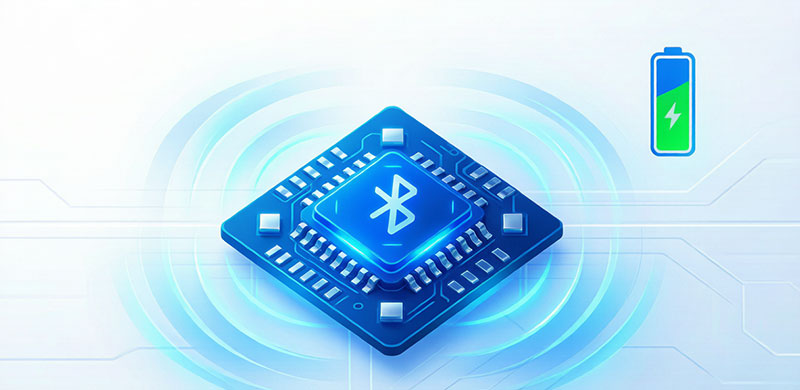
Sơ đồ khái niệm về Bluetooth Low Energy (BLE) mô-đun hiển thị MCU tích hợp, máy thu phát RF, và mạch anten
TÔI. What is a Bluetooth Low Energy Module? Redefining “Kết nối”
A Bluetooth năng lượng thấp (BLE) mô-đun is an embedded module that highly integrates the Bluetooth 4.0/5.0 and above protocol stack, máy thu phát RF, microcontroller (MCU), and antenna matching circuitry onto a small PCB board.
Unlike Bluetooth cổ điển, BLE technology is not simply a “low-power version of Bluetooth,” but a completely new communication architecture. Designed specifically for small data packets and low-frequency transmissions, it truly realizes the vision of “powering devices for years on a single button battery.”
A mature Bluetooth transmission module allows developers to enable wireless transmission capabilities without needing expertise in RF antenna design and complex impedance matching. This is achieved simply through serial port commands, significantly lowering the development barrier for SMEs and startups without dedicated RF teams.
II. Nguyên tắc công nghệ cốt lõi: Tại sao BLE có thể đạt được mức tiêu thụ điện năng cực thấp?
Để chọn mô-đun Bluetooth công suất thấp tốt, điều cần thiết là phải hiểu logic tiết kiệm năng lượng của nó. Điều này chủ yếu là do ba cơ chế sau:
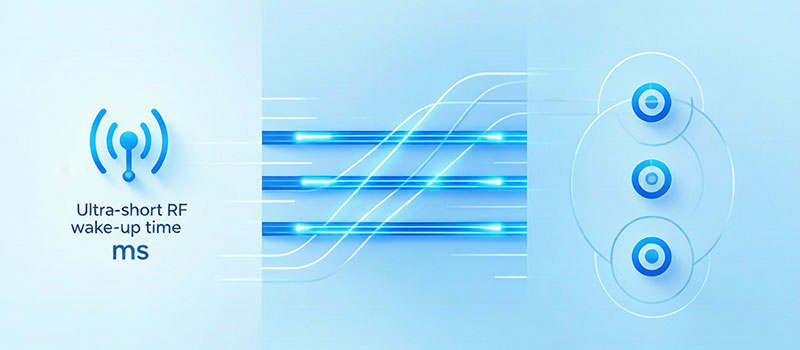
1. Thời gian RF cực ngắn (Chu kỳ làm việc cực thấp)
Bluetooth truyền thống yêu cầu tiêu thụ điện năng liên tục để duy trì kết nối khi bật nguồn. BLE, Tuy nhiên, chỉ thức dậy trong khoảnh khắc ngắn ngủi khi cần truyền dữ liệu, hoàn thành việc truyền gói dữ liệu chỉ trong vài mili giây trước khi nhanh chóng chuyển sang trạng thái ngủ sâu. Chu kỳ hoạt động cực kỳ thấp này là lý do cơ bản tại sao BLE có thể duy trì dòng điện trung bình trong phạm vi µA.
2. Các kênh phát sóng được tối ưu hóa và nhảy tần thích ứng (AFH)
Chỉ sử dụng các mô-đun Bluetooth Low Energy 3 kênh phát sóng (sử dụng Bluetooth truyền thống 32), dẫn đến tốc độ kết nối và phát hiện thiết bị cực nhanh. Sau khi kết nối, Nhảy tần thích ứng (AFH) tự động tránh các kênh gây nhiễu như Wi-Fi, đảm bảo sự ổn định của đường truyền Bluetooth và ngăn chặn việc tiêu thụ điện năng khi truyền lại do tắc nghẽn tín hiệu.
3. Thông số kết nối linh hoạt và chế độ PHY
Bluetooth mới nhất 5.0 Các mô-đun Năng lượng thấp hỗ trợ LE 1M PHY, LÊ 2M PHY, và PHY mã hóa LE, cho phép cân bằng linh hoạt giữa tốc độ truyền thông và khoảng cách truyền.
| Chế độ vật lý | Tỷ lệ | Khoảng cách điển hình | Các tình huống áp dụng |
|---|---|---|---|
| LÊ 1M PHY | 1 Mb/giây | ~30~100m | Cảm biến đa năng, nhà thông minh |
| LÊ 2M PHY | 2 Mb/giây | ~20~60m | Truyền dữ liệu thông lượng cao |
| LE Mã hóa PHY(S=8) | 125 Kbps | 300m+ | Đường dài, kịch bản năng lượng thấp |
III. Sáu ưu điểm cốt lõi của mô-đun truyền năng lượng thấp Bluetooth
1. Kiểm soát mức tiêu thụ năng lượng cực cao: Dòng điện ngủ có thể đạt tới mức μA, và dòng điện hoạt động trung bình dưới mức mA, làm cho nó trở nên lý tưởng cho các mô-đun Bluetooth IoT chạy bằng pin.
2. Khả năng tương thích đa nền tảng: Tương thích hoàn toàn với điện thoại thông minh, máy tính bảng, và máy tính, không yêu cầu cổng bổ sung. Đây là lợi thế của hệ sinh thái mà các giao thức như Zigbee và Z-Wave chưa từng có. 3. Chi phí thấp: Với công nghệ trưởng thành, Các mô-đun Bluetooth BLE được sản xuất trong nước mang lại hiệu quả chi phí tuyệt vời, với lợi thế chi phí đáng kể cho sản xuất hàng loạt quy mô lớn.
4. Bảo mật cao: Hỗ trợ mã hóa AES-128/256 và ghép nối an toàn, đáp ứng nhu cầu truyền dữ liệu của các ứng dụng y tế và tài chính.
5. Chế độ truyền trong suốt Plug-and-Play: Hầu hết các mô-đun Bluetooth truyền dữ liệu đều hỗ trợ truyền trong suốt cổng nối tiếp, loại bỏ nhu cầu người dùng sửa đổi kiến trúc mã của các sản phẩm có dây hiện có, dẫn đến ngưỡng phát triển rất thấp.
6. Khả năng kết nối mạng nâng cao: Bluetooth 5.4 đặc điểm kỹ thuật giới thiệu các tính năng như Phản hồi phát sóng định kỳ (PAwR), làm cho các mô-đun Bluetooth Low Energy trở nên hứa hẹn hơn trong mạng hệ thống quy mô lớn một-nhiều, chẳng hạn như Thẻ kệ điện tử (ESL).
IV. Hướng dẫn lựa chọn cần thiết: 7 Các thông số chính cho mô-đun truyền năng lượng thấp Bluetooth
Trước khi mua Mô-đun Bluetooth năng lượng thấp, hãy chắc chắn kiểm tra những điều sau đây 7 các thông số chính để tránh những cạm bẫy:
Phiên bản Bluetooth: Nên chọn 5.0 hoặc cao hơn. So với 4.2, khoảng cách truyền tăng lên bởi 4 lần, dung lượng gói dữ liệu quảng bá được tăng lên bởi 8 lần, và nó tương thích ngược với các thiết bị cũ hơn.
Vai trò chủ/nô lệ: It is necessary to clarify whether the device is a master (scanning connection), a slave (broadcast connection), or a master-slave hybrid. For mobile phone peripherals, choose slave; for gateway devices, choose master; for flexible switching, choose a master-slave hybrid module.
Chip Solution: Mainstream solutions include Nordic (most complete ecosystem), TI, Telink, and Fengjia. Domestic solutions offer high cost-effectiveness, performance comparable to international giants, and guaranteed mass production consistency.
Transmit Power and Receive Sensitivity: Both determine the low-power Bluetooth transmission distance. High-end modules can achieve +20dBm transmit and -103dBm receive, meeting long-distance transparent transmission requirements.
Power Consumption Performance: A real power consumption test report must be obtained, distinguishing between peak current and sleep current, especially focusing on average power consumption in connected mode, as this is the determining factor for battery life.
Interface and Size: Select interfaces such as UART, SPI, and I2C as needed. Wearable devices require small-size stamp-type packaging, while industrial equipment can use pin-type packaging. DIP packaging facilitates development and debugging.
Whether it has an integrated MCU: Pure transparent transmission modules are inexpensive and quick to develop; smart modules with integrated MCUs allow for customized firmware, enabling local logic processing, saving main control resources, and are suitable for products with strict BOM requirements.
V.. Typical Application Scenarios: What can BLE modules do?
5.1 Chăm sóc sức khỏe: Digital Chronic Disease Management
Blood glucose meters, pulse oximeters, and temperature patches upload vital sign data in real time to a mobile app via BLE low-power Bluetooth modules, enabling digital chronic disease management. The extremely low power consumption of BLE modules ensures long battery life for medical devices, while AES-128 encryption meets the privacy and security requirements of medical data. Medical-grade products should use modules that have passed BQB certification to reduce FDA/CE certification compliance risks.
5.2 Industrial IoT: Long-Term Maintenance-Free Operation in Harsh Environments
Vibration sensors and temperature/humidity loggers utilize the ultra-low power consumption of Bluetooth Low Energy (BLE) mô-đun, enabling long-term maintenance-free operation in harsh environments such as factories and warehouses. Industrial-grade modules must support operating temperatures from -40°C to 85°C. With a dustproof and waterproof housing, their typical lifespan can reach 3-5 years or more, completely replacing wired wiring solutions.
5.3 Điện tử ô tô: Digital Car Keys and OBD Diagnostics
OBD fault diagnosis and digital car keys employ automotive-grade Bluetooth transmission modules, meeting high-speed connectivity and information security requirements. The digital car key solution is based on BLE proximity sensing; the phone automatically unlocks the vehicle when it approaches. Combined with the CCC 3.0 standard, it achieves sub-meter accuracy in location determination and is secure against replay attacks.
5.4 Asset Tracking and Indoor Positioning
BLE beacons do not rely on GPS and utilize RSSI or AoA/AoD angle measurement technology to achieve indoor positioning with sub-meter accuracy. Widely used in hospital asset management, warehouse inventory, exhibition hall navigation, và các kịch bản khác. The direction finding feature introduced in BLE 5.1 further improves indoor positioning accuracy.
VI. Avoidance Guide: Common Misconceptions in Purchasing Low-Power Bluetooth Transmission Modules
- Blindly Pursuing “Longest Distance” — Long distance often means high power consumption and large antenna size. A balance between distance and power consumption is necessary. For most indoor scenarios, 30-50m is sufficient; pursuing 300m at will sacrifice battery life.
- Ignoring Secondary Development Resources — Buying hardware without considering the SDK is a disaster. Ensure the supplier provides complete example programs, a mobile debugging app, and RF testing support; nếu không thì, the integration testing phase will consume a significant amount of time.
- Underestimating Certification Costs — Exported products must use mô-đun Bluetooth certified by BQB, FCC, CE, RoHS, vân vân., which greatly reduces compliance risks and time costs for the terminal. Choosing certified modules can save tens of thousands of yuan in certification fees.
- Focusing solely on unit price while ignoring consistency—RF consistency directly determines the connectivity experience. Low-priced modules often cut corners on crystal oscillator frequency offset and antenna matching, leading to frequent connection drops in batches, with after-sales costs far exceeding the saved hardware costs.
- Ignoring supply chain stability—choose module manufacturers with mature supply chain guarantees to ensure production line shutdowns during mass production due to chip supply disruptions. MOQ, delivery time, and inventory strategies should be confirmed in advance.
VII. Ansiot Technology Recommendations: BLE Module Solutions Covering Diverse Needs
Ưu điểm công nghệ, a professional manufacturer of IoT wireless communication modules, offers a product matrix of BLE modules covering different power consumption, kích cỡ, and connectivity requirements:
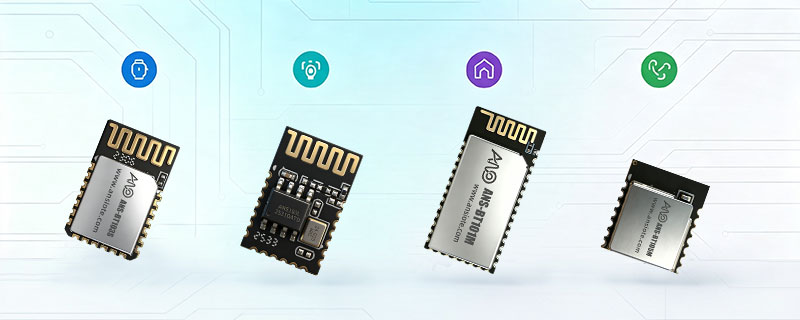
ANS-BT103S:
BLE 5.2 · 16×10mm ultra-small size · Master-slave integrated · HID wireless backlink
Suitable for wearables, medical devices, and car keys
ANS-BT103L:
BLE 5.4 · Low cost and low power consumption · Slave-end serial port pass-through
Suitable for sensors, nhà thông minh, and beacons
ANS-BT101M:
BLE 5.x · Tích hợp Master-Slave · Lệnh AT phong phú · Truyền qua Master-end
Thích hợp cho các cổng, thiết bị đầu cuối cầm tay, và thu thập dữ liệu
ANS-BT105M:
BLE 5.x · Kích thước siêu nhỏ · 3 Bậc thầy 3 Đa kết nối nô lệ
Thích hợp cho các cổng thu thập dữ liệu song song đa cảm biến
VIII. Câu hỏi thường gặp Câu hỏi thường gặp
Sau đây là những câu hỏi thường gặp nhất của các kỹ sư và người quản lý sản phẩm khi lựa chọn mô-đun BLE:
Sự khác biệt giữa Bluetooth Năng lượng thấp (BLE) mô-đun và Bluetooth cổ điển?
BLE không phải là phiên bản Bluetooth cổ điển có công suất thấp hơn, nhưng một kiến trúc truyền thông hoàn toàn mới được thiết kế cho các gói dữ liệu nhỏ và truyền tần số thấp. Dòng điện ngủ BLE có thể thấp tới mức µA, làm cho nó phù hợp với các thiết bị chạy bằng pin; Classic Bluetooth has higher throughput and is suitable for audio transmission. In practical selection: prioritize BLE for sensors, health devices, vân vân.; choose Classic Bluetooth or a dual-mode (SPP+BLE) solution if audio transmission is required.
What is the actual transmission distance of a BLE module?
In a standard indoor environment, the typical transmission distance of a BLE 5.0 module is approximately 30–100 meters. Using LE Coded PHY (long-range mode), it can reach over 300 meters in open environments. High-end modules with a transmit power of +20dBm and a receive sensitivity of -103dBm can maintain a stable connection even through several floors. Actual distance is affected by environmental obstructions, 2.4GHz interference, vân vân., so actual testing is recommended.
What is Bluetooth serial port pass-through? Does development require knowledge of the Bluetooth protocol stack?
Bluetooth serial port pass-through refers to using the BLE module as a wireless serial cable. The MCU sends data via UART, and the module automatically establishes and transmits the Bluetooth link. The remote MCU receives the data via its serial port. Developers do not need to understand the details of the Bluetooth protocol stack such as GATT/ATT, significantly reducing the development threshold. Typical integration time is only one week.
What are the sleep current and operating current of the BLE module?
The sleep current of a mature BLE module can be as low as 1-5 µA, the average current in broadcast mode is approximately 10-50 µA (depending on the broadcast interval), and the average current in connected mode is approximately 1-5 mA. Ví dụ, pin nút 500mAh có thể tồn tại trong vài năm ở chế độ chờ thuần túy và vài tháng đến hơn một năm ở chế độ phát sóng tần số thấp. Luôn yêu cầu báo cáo mức tiêu thụ điện đo được từ nhà cung cấp, thay vì chỉ dựa vào các giá trị lý thuyết trong bảng dữ liệu chip.
Cần có những chứng chỉ nào để mua mô-đun BLE?
- Bán hàng nội địa: SRRC (Phê duyệt loại đài phát thanh, do Bộ Công nghiệp và Công nghệ thông tin ban hành)
- Xuất khẩu sang Mỹ: ID FCC
- Xuất khẩu sang EU: MÀU ĐỎ
- Khả năng tương tác Bluetooth: BQB (Chứng chỉ Bluetooth)
- Sản phẩm y tế: ISO 13485, FDA, vân vân.
Việc chọn các mô-đun đã vượt qua các chứng nhận trên có thể giảm đáng kể chi phí tuân thủ và thời gian chứng nhận cho sản phẩm cuối cùng.
Cái gì Bluetooth năng lượng thấp (BLE) mô-đun Công nghệ Ansiot có cung cấp không?
Công nghệ Ansiot cung cấp hàng loạt mô-đun BLE để đáp ứng các nhu cầu khác nhau: ANS-BT103S (BLE 5.2, ultra-small size 16×10mm, master/slave integrated, HID backlink), ANS-BT103L (BLE 5.4, low-cost, low-power slave transparent transmission), ANS-BT101M (BLE 5.x, master/slave integrated, rich AT commands), and ANS-BT105M (3 master, 3 slave multi-connection). Free samples are available for all models, along with complete development materials and one-on-one technical support.
IX. Phần kết luận
Trong kỷ nguyên Internet vạn vật, Bluetooth năng lượng thấp (BLE) mô-đun are no longer simply data transmission bridges, but rather keys to lowering development barriers and accelerating product launches. Only by deeply understanding their technical essence, strictly controlling selection parameters, and choosing solutions with mature technical support and a reliable supply chain can this small “mô-đun” become the strongest moat for your product.
Core Selection Principles Review:
- Power Consumption Priority — Request actual test reports and focus on average power consumption in connected mode;
- Size Adaptability — Select the package according to product space constraints; choose a small package with a stamp-sized form factor for wearable devices;
- Flexible Roles — Choose a master-slave integrated module when master-slave requirements are uncertain to reduce BOM complexity;
- Certification Compliance — Confirm the required certifications for the target market in advance and prioritize certified modules;
- Technical Support — Choose a supplier that can provide a complete SDK, examples, and after-sales technical support.