

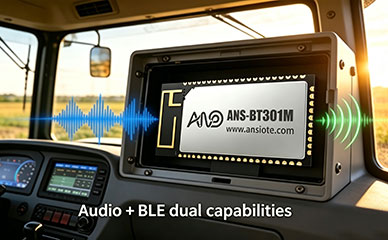
With the rapid development of smart agriculture, agricultural machinery is upgrading from “mechanization” ile “intelligentization, networking, and human-machine interaction.” Traditional agricultural machinery instruments and controllers are no longer just data display terminals, but are gradually becoming the information interaction center of the entire vehicle. Under this trend, Bluetooth audio modules have also upgraded from functional modules that simply “play music” to intelligent interaction cores that integrate “ses + data communication.” Among them, the ANS-BT301M Bluetooth ses modülü, with its “ses + BLE dual capabilities,” rich interfaces, and mature command system, is being widely used in agricultural machinery instruments, agricultural machinery domain controllers, smart cockpits, ve diğer senaryolar.
BEN. Limitations of Traditional Bluetooth Audio Solutions
In the past, Bluetooth audio modules in agricultural machinery primarily functioned only for: Bluetooth music playback, Bluetooth phone calls, and mobile phone audio transmission. While this solution addressed the needs of driving entertainment and communication, it still has significant shortcomings for modern intelligent agricultural machinery:
It cannot configure equipment parameters.
It cannot read instrument operating data.
It cannot achieve data interaction between mobile phones and instruments.
Engineers need to add an additional BLE module.
High system complexity, high cost, and long development cycle.
1. Pure audio solutions cannot meet data interaction needs.
In traditional pure audio Bluetooth solutions, the module only performs two roles: A2DP (Advanced Audio Distribution Protocol) ve HFP (Hands-free Protocol)—namely, “playing music” Ve “answering calls.” Fakat, the wireless connectivity needs of intelligent agricultural machinery go far beyond this: engineers need to view operating parameters such as engine speed, oil temperature, and hydraulic pressure in real time via a mobile app, remotely configure the ECU’s operating mode, and obtain alarm information immediately when a fault occurs. Pure audio solutions cannot achieve these data interaction functions, forcing agricultural machinery manufacturers to develop additional wired communication interfaces or independent data transmission solutions, increasing system complexity. 2. Increased Cost and Complexity Due to the Addition of an Additional BLE Module
To compensate for the lack of data communication in pure audio solutions, many agricultural machinery manufacturers choose to add an additional BLE low-power Bluetooth module (such as a BLE module) to the system for parameter configuration and data transmission between the mobile phone and the instrument panel. While this “dual-module” solution is functionally feasible, it brings significant negative impacts:
Double Hardware Costs: Two modules, two antennas, and two sets of peripheral circuits significantly increase BOM costs.
Increased PCB Area: Agricultural machinery instrument panels have limited space; dual modules occupy more PCB area.
Increased Software Development Complexity: Two Bluetooth protocol stacks and drivers need to be maintained simultaneously.
Extended System Debugging Cycle: The coexistence and interference of the audio module and the BLE module require additional debugging and certification.
Especially with the rapid development of intelligent agricultural machinery, unmanned agricultural machinery, and autonomous agricultural machinery, traditional pure audio Bluetooth solutions can no longer meet the market’s demand for integrated “ses + veri” communication.
II. ANS-BT301M: Ses + BLE Integrated Solution
The ANS-BT301M not only supports traditional Bluetooth audio and telephone functions but also integrates BLE (Brain Low Energy) Bluetooth functionality, achieving integrated “ses + data communication.” Compared to traditional solutions, the ANS-BT301M can directly communicate with a mobile app or WeChat mini-program via BLE, enabling:
Instrument parameter setting
ECU parameter configuration
Controller parameter reading
Fault information query
Agricultural machinery operating status viewing
Data pass-through
Command control
1. BLE Communication: Instrument Parameter Setting and ECU Configuration
Through the BLE channel integrated into the ANS-BT301M, engineers or operators can use a mobile app or WeChat mini-program to wirelessly connect to agricultural machinery instruments for parameter setting. Örneğin, setting engine alarm thresholds, configuring hydraulic system operating parameters, and calibrating sensor zero points. Similarly, ECU parameter configuration can also be completed remotely via BLE without opening the instrument casing to connect data cables, significantly improving the efficiency of on-site debugging and after-sales maintenance. Bu “wireless configuration” method is particularly useful in the mass deployment of large tractors and harvesters—technicians can approach each device sequentially and quickly send parameters via their mobile phones, without needing to carry laptops and data cables.
2. Data Transparency and Command Control
The ANS-BT301M BLE channel supports transparent transmission mode (data transparency). This means that the main control MCU of the agricultural machinery instrument can send data packets to the module via the UART serial port, and the module automatically forwards them to the mobile phone via BLE, and vice versa. This transparent transmission mechanism allows engineers to achieve bidirectional data communication without needing in-depth knowledge of the Bluetooth protocol stack; they can simply operate it like a serial port. Üstelik, the ANS-BT301M also supports command control mode. The mobile app can send predefined AT commands to directly control the module’s behavior (such as switching audio sources, adjusting volume, and checking connection status), providing flexible control methods for intelligent agricultural machinery systems.
3. Applicable Scenarios: Agricultural Machinery Smart Instruments, Domain Controllers, and Unmanned Agricultural Machinery
Engineers can complete the development of dual audio and data functions without adding an additional BLE module, significantly reducing hardware costs, PCB space occupation, software development difficulty, and system debugging complexity. The ANS-BT301M is particularly suitable for the following scenarios:
Agricultural Machinery Smart Instruments: A comprehensive display terminal integrating audio playback, arayan kimliği, and parameter configuration.
Agricultural Machinery Domain Controllers: Serving as the information interaction center for the entire vehicle, simultaneously handling wireless connections for both audio and data.
Harvester Control Systems: In dusty and vibrating operating environments, Bluetooth wireless connections are more reliable than wired connections.
Tractor Smart Cockpits: Providing drivers with a comprehensive experience including music entertainment, eller serbest arama, and instrument parameter viewing.
Plant Protection Machinery Control Terminals: Remotely monitoring spraying parameters and operating status via BLE.
Unmanned Agricultural Machinery Systems: The BLE channel is used for remote status monitoring and command issuance, while the audio channel is used for alarm broadcasting.
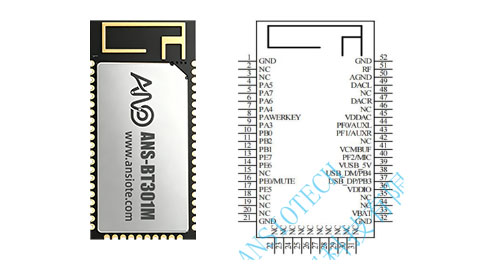
III. Rich Audio Interfaces to Meet Diverse Agricultural Machinery Application Needs
Agricultural machinery application environments are complex, and different customers have significantly different needs for audio input methods. The ANS-BT301M offers a rich array of audio input interfaces, fully covering various application scenarios.
1. Multi-source input: Bluetooth/AUX/TF card/USB flash drive
The ANS-BT301M audio input interfaces include four methods: Bluetooth ses, AUX input, USB flash drive playback, and TF card playback, basically covering all common audio source needs in agricultural machinery scenarios:
Bluetooth ses: Drivers can wirelessly play music or answer calls via their mobile phones, the most commonly used daily function.
AUX input: Connects to external audio sources (such as walkie-talkies, radio receivers) via a 3.5mm audio cable, compatible with older equipment.
USB flash drive playback: Directly plays pre-stored audio files by inserting a USB flash drive, suitable for voice broadcasts in fixed scenarios.
TF card playback: Similar to a USB flash drive, but smaller in size, more suitable for scenarios with high dust and shock resistance requirements, such as embedding within instruments.
2. Voice broadcast applications: Fault warnings and operation guidance
Whether it’s wireless playback from a mobile phone or local voice file playback, the ANS-BT301M can easily support it. In agricultural machinery scenarios, voice broadcasting functionality is particularly important:
Machinery Fault Voice Broadcasting: When sensors detect abnormalities (such as excessively high oil temperature or insufficient hydraulic pressure), the system automatically broadcasts the fault type and suggested handling methods, eliminating the need for the driver to look down at the instruments.
Operation Prompts: During operations such as sowing, fertilizing, and spraying, the system broadcasts progress updates and area switching prompts.
Safety Warning Voice Broadcasting: Safety reminders are broadcast when reversing, turning, or approaching obstacles, reducing the risk of accidents.
Local Voice Navigation: In remote farmland without mobile signal, offline navigation broadcasting is achieved through pre-stored voice packages on a TF card.
Operation Guidance Voice Broadcasting: During training on new equipment, voice guidance on operating steps is played, lowering the learning curve.
These voice files can be played offline via USB flash drive or TF card, without relying on a mobile network connection, making them particularly suitable for remote farmland operating environments.
IV. Supports Stereo and I2S Output, Adapting to Different System Architectures
The ANS-BT301M not only offers rich inputs but also flexible output interfaces, providing both stereo analog output and I2S digital audio output formats to meet the needs of different levels of agricultural machinery platforms. Stereo Analog Output: Rapid Mass Production of Traditional Amplifiers
Stereo analog output is the most basic audio output method of the ANS-BT301M, suitable for interface with traditional analog amplifier solutions. Its advantages include:
Simple Development: Direct connection to the amplifier chip is sufficient, requiring no additional digital-to-analog converter circuitry.
High Compatibility: The vast majority of agricultural machinery audio systems on the market still use analog input interfaces.
Rapid Mass Production: Simple peripheral circuitry and short design cycle, suitable for cost-sensitive low-to-mid-range agricultural machinery platforms.
For traditional agricultural machinery instrument upgrade projects, the stereo analog output solution allows for functional upgrades without replacing the original amplifier and speakers, simply by replacing the Bluetooth module, minimizing modification costs.
I2S Digital Output: High-End Domain Controller Access to DSP/SoC
I2S (Inter-IC Sound) digital audio output is suitable for high-end agricultural machinery domain control systems and intelligent cockpit platforms, offering the following significant advantages:
Better sound quality: Digital signal transmission avoids noise interference and distortion inherent in analog signal transmission.
Stronger anti-interference capability: Agricultural machinery operating environments are subject to significant electromagnetic interference (generators, motors, relays, vesaire.), and I2S digital signals are naturally immune to this interference.
Better suitability for digital audio architectures: Modern high-end domain control systems typically use DSPs or SoCs for audio processing (such as noise reduction, equalization, and 3D sound effects), and I2S output can directly interface with these digital processing chips.
Easy access to main control SoC: No additional ADC conversion is required, simplifying the signal chain.
Bu “analog + digital” dual output design allows the ANS-BT301M to simultaneously serve the traditional agricultural machinery upgrade market and the emerging high-end agricultural machinery domain control market, providing manufacturers with flexible hardware design options.
V. Supports Serial Output of Incoming Call Numbers, Enhancing the Intelligent Interaction Experience of the Instrument
In traditional Bluetooth audio solutions, users can only hear the ringtone when a call comes in; the number information cannot be displayed on the instrument. The ANS-BT301M supports serial output of incoming call numbers, bringing a more intelligent human-machine interaction experience to agricultural machinery instruments.
1. Incoming Call Number Parsing and Instrument Display
When a mobile phone receives a call, the ANS-BT301M module automatically parses the incoming call number information and outputs the caller ID data to the instrument’s main control MCU via the UART serial port. After receiving the number, the instrument can display the caller information on the display screen in real time, allowing the driver to determine whether to answer the call without taking out their phone. This function is particularly useful in agricultural machinery driving scenarios—drivers typically need both hands to operate the steering wheel and joystick, and looking down at their phone poses a safety hazard. The incoming call display function can also be linked with the address book, displaying the contact’s name instead of a purely numerical number, further enhancing the user experience.
2. Large Tractors and Long-Term Outdoor Operation Scenarios
The caller ID serial port output function is particularly suitable for the following scenarios:
Large Tractors: The distance between the cab and the mobile phone is relatively far (örneğin, the control area for rear-mounted implements), making incoming call reminders easily overlooked.
Harvesters: High operating noise makes ringtones difficult to hear; instrument displays provide a more intuitive experience.
Long-Term Outdoor Operation Equipment: Working continuously for several hours, the mobile phone may be in a bag or charging; instrument call displays ensure that important calls are not missed.
Intelligent Agricultural Machinery Cockpit: As part of the human-machine interaction, it forms a unified interface experience with other information displays on the instrument panel.
VI. Sıkça Sorulan Sorular (SSS)
1. Çeyrek: What audio decoding formats does the ANS-BT301M support?
The ANS-BT301M supports two mainstream Bluetooth audio decoding formats: SBC and AAC, covering the encoding output of most mobile phones and audio sources, meeting the audio quality requirements for music playback and voice calls in agricultural machinery scenarios.
2. Çeyrek: How to integrate the BLE communication function of ANS-BT301M into agricultural machinery instruments?
The integration process is very simple: Connect the ANS-BT301M to the instrument’s main control MCU via a UART serial port, configure BLE parameters (such as broadcast name, connection interval, vesaire.) using AT commands, and a BLE data channel between the mobile app and the instrument can be established. The module supports transparent transmission mode; the MCU only needs to send and receive data like operating a serial port, without needing in-depth knowledge of the Bluetooth protocol stack. The development cycle can usually be controlled within 1-2 haftalar.
3. Çeyrek: What is the cost difference between the ANS-BT301M and a pure audio Bluetooth module?
Although the price of a single ANS-BT301M is higher than that of a pure audio module, the overall BOM cost is actually lower. This is because traditional solutions require “pure ses modülü + external BLE module + two sets of peripheral circuits,” while the ANS-BT301M chip can replace the functions of two modules. In actual calculations, the overall hardware cost can be reduced by 30-50%, and the PCB area can be saved by more than 40%.
Q4: Does the ANS-BT301M operate stably in environments with strong electromagnetic interference?
The ANS-BT301M has a maximum transmit power of 9dBm and a receive sensitivity of -97dBm, maintaining a stable connection even in common electromagnetic interference environments in agricultural machinery (generators, motors, relays, vesaire.). For audio output, it is recommended to use I2S digital output in strong interference scenarios to effectively avoid noise interference during analog signal transmission.
Q5: Does the ANS-BT301M support direct connection via WeChat Mini Program?
Evet. The ANS-BT301M’s BLE channel is compatible with WeChat Mini Program Bluetooth APIs (wx.writeBLECharacteristicValue, vesaire.), allowing developers to directly implement BLE communication with the module within WeChat Mini Programs without developing a separate app. This significantly lowers the barrier to entry for end users—agricultural machinery operators only need to open WeChat and scan a QR code to connect to the instrument for parameter viewing and configuration.
Q6: Can the ANS-BT301M’s audio and BLE functions operate simultaneously?
Evet. The ANS-BT301M’s audio channel (A2DP/HFP) and BLE channel are independent and can operate simultaneously. This means that the driver can play music via Bluetooth while simultaneously viewing instrument data on a mobile app via the BLE channel, with the two functions operating without interference.
Özet
In today’s continuously developing smart agriculture, agricultural machinery electronic systems are undergoing rapid intelligent upgrades. The ANS-BT301M is no longer just a “Bluetooth ses modülü,” but a comprehensive intelligent wireless connectivity solution integrating audio playback, Bluetooth calling, BLE communication, veri geçişi, parametre konfigürasyonu, and human-machine interaction. For agricultural machinery instrument and domain controller manufacturers, the ANS-BT301M not only reduces development difficulty and hardware costs but also helps products quickly achieve intelligent upgrades, enhancing market competitiveness.
Whether you are developing a new generation of intelligent agricultural machinery instruments or upgrading the wireless connectivity of your existing domain controller platform, the ANS-BT301M provides a simple solution of “one module, dual capabilities.” For more information on Bluetooth audio solutions or to obtain the ANS-BT301M development kit, please contact the Anshuo Technology technical team.