

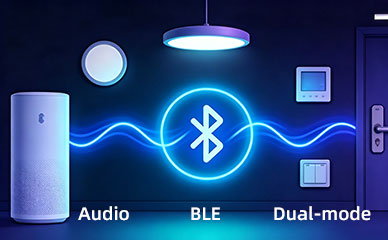
In the era of the Internet of Things, Bluetooth modules are no longer just “connection tools,” but rather the core engine for product intelligence and enhanced user experience. Whether it’s a two-wheeled vehicle dashboard, smart hardware, or audio terminal equipment, choosing the right Bluetooth module often determines a product’s competitiveness. With the widespread adoption of Bluetooth 5.0 and above protocols, Bluetooth communication modules have made significant leaps in transmission speed, power consumption control, and multi-device connectivity. Different types of Bluetooth modules differ significantly in their functional positioning, and the appropriate selection directly impacts the product’s time-to-market and user experience.
Below, we’ll start with three mainstream Bluetooth module types to quickly understand their core advantages and application value.
I. Dual-Mode Bluetooth Modules: The “All-Round Player” of Connectivity and Compatibility
Dual-mode Bluetooth (Classic + BLE) balances high-speed transmission and low-power communication, making it one of the most widely used solutions. Classic Bluetooth (BR/EDR) provides a stable high-speed data channel, while BLE handles low-power continuous connection and status synchronization. The two modes work together on the same chip, enabling dual-mode Bluetooth modules to simultaneously meet multiple needs such as data transmission, audio streaming, and IoT control, making them particularly suitable for product designs requiring “one chip for multiple uses.”
1. High-speed transmission + multi-protocol support
Supports SPP / BLE / HID protocols, flexibly adapting to different communication scenarios.
Supports a high baud rate of 921600, with a maximum data transmission rate of 80KB/s.
Built-in rich AT command set, facilitating development and debugging, shortening product launch cycle.
Suitable for: Industrial equipment, smart terminals, and other devices requiring stable data communication and human-machine interaction.
2. Strong multi-device connectivity
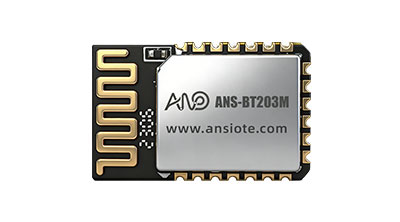
ANS-BT202M Dual-mode Bluetooth Module
Supports simultaneous connection of 7 Android devices + 1 Apple device.
Multi-channel parallel data processing meets the needs of simultaneous interaction by multiple users.
Specially optimized multi-device switching latency ensures a smooth experience in concurrent scenarios.
Suitable for: Portable printers, delivery printers, and other multi-user control scenarios.
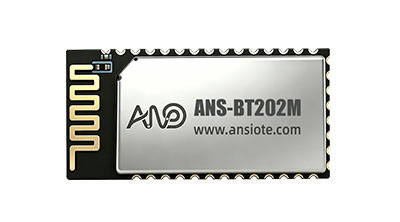
3. Automatic host reconnection for a seamless experience
Supports automatic reconnection by name / Automatic address connection, connects instantly upon power-on, no manual intervention required.
Memory pairing list, reconnects in seconds after disconnection, providing a seamless user experience.
Suitable for: “plug and play” scenarios such as instrumentation and industrial terminals.
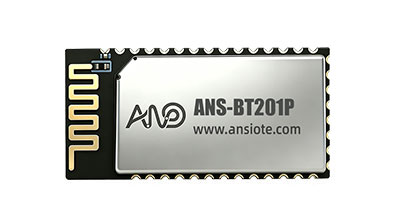
II. BLE Bluetooth Module: The Ultimate Solution for Low Power Consumption and High Connectivity
BLE (Bluetooth Low Energy) is the “battery lifesaver” for smart devices, especially suitable for battery-powered devices. Compared to classic Bluetooth, BLE’s peak power consumption is only 1/10 to 1/100 of traditional solutions. It quickly switches between broadcast, sleep, and burst data transmission states, allowing button battery-powered devices to operate continuously for months or even years. In the fields of IoT, smart homes, and wearables, BLE has almost become the standard communication method.
1. Master-Slave Integration, Strong Multi-Connectivity:
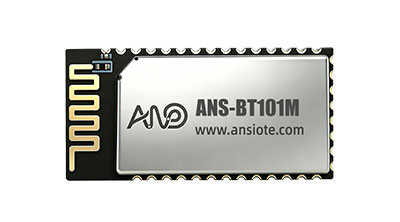
ANS-BT101M BLE Low-Power Bluetooth Module
Supports a master-slave integrated architecture, functioning as both a central and peripheral device.
Supports up to 9 connections, offering flexible networking capabilities.
Complies with Bluetooth 5.0 protocol, providing strong broadcast expansion capabilities.
Suitable for: IoT gateways, multi-device control centers, smart home hubs.
2. HID Support, Seamless Interaction:
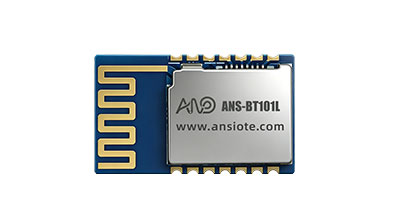
Supports HID (Human Interface) functionality, allowing for recognition by mobile phones/tablets without additional drivers.
Enables seamless unlocking of two-wheeled vehicle dashboards, proximity-based unlocking, and other interaction methods.
Low-power broadcast + HID combination solution, offering excellent battery life.
Suitable for: Smart door locks, vehicle systems, and identity recognition scenarios.
3. Ultra-Small Size, Ultimate Integration:
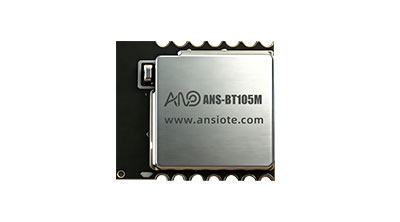
Smaller than a fingernail, industry-leading ultra-small package.
Easily embedded in various micro-devices, saving PCB space.
Small size without sacrificing functionality, fully supports BLE. 5.0 Protocol Stack
Suitable for: Wearable devices, portable smart hardware, miniature sensors
III. Audio Bluetooth Module: The Core Hub for Entertainment and Interaction
The audio Bluetooth module not only “listens” but also “controls,” making it a key component of smart audio devices. With the widespread adoption of smart voice assistants and in-vehicle entertainment systems, the audio Bluetooth module has evolved from simple audio transmission into a comprehensive solution integrating audio decoding, data communication, and intelligent control, possessing irreplaceable advantages, especially in scenarios where a single chip enables dual “audio + data” channels.
1. Parallel Audio and Data Processing
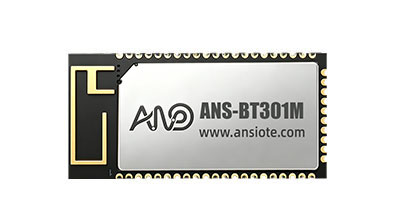
Supports simultaneous audio transmission and BLE data communication, integrating multiple functions into a single module.
Avoids the redundant design of traditional dual-chip “audio module + data module,” reducing BOM cost and PCB area.
2. Rich Information Synchronization Capabilities
Supports lyrics display and phonebook synchronization (PBAP protocol).
Provides a more complete human-computer interaction experience, adaptable to automotive and smart terminal scenarios.
3. Multiple Input and Output Interfaces
Inputs support BT/USB/AUX/TF cards, compatible with various audio sources.
Outputs support stereo analog/I2S digital audio, meeting the design needs of audio systems from entry-level to high-end.
4. Upgraded Intelligent Control Experience
Supports playback progress synchronization and sound effect adjustment, with a control experience comparable to the native mobile phone player.
Supports mobile phone AI voice wake-up (such as Siri, Xiao Ai), creating a more intelligent voice interaction experience.
5. Low Power Consumption Design
Deep sleep mode only… 1mA, balancing performance and battery life, suitable for long standby scenarios in vehicles and portable devices.
IV. How to Choose the Right Bluetooth Module? – Selection Comparison Table
When faced with different types of Bluetooth modules, many engineers easily fall into the misconception that “the more features, the better.” In fact, the core logic of selection is scenario-driven: based on the product’s power consumption budget, connectivity requirements, data throughput, and functional requirements, reverse-match the most suitable module type and model. The following comparison table can help you quickly locate the right one:
| Selection Criteria | Dual-Mode Bluetooth Module |
BLE Bluetooth Module |
Audio Bluetooth Module |
|---|---|---|---|
| Core Advantage | High-speed transmission + Multi-protocol compatibility |
Ultra-low power consumption + Multi-connection support |
Audio decoding + Dual-channel data communication |
| Power Level | Medium (must accommodate Classic Bluetooth) |
Very Low (suitable for battery-powered devices) |
Medium-High (audio decoding consumes more power) |
| Typical Connections | 1~8 connections | 1~9 connections | 1~2 connections |
| Audio Support? | No (requires audio variant model) |
No | Yes (SBC/AAC codec decoding) |
| Typical Applications | Printers, Industrial terminals, Instruments / Meters |
Smart locks, Wearables, Gateways |
Vehicle audio, Speakers, Agricultural machinery instruments |
| Representative Models | BT203M / BT202M / BT201P |
BT101M / BT101L / BT105M |
BT301M |
V. Frequently Asked Questions (FAQ)
Q1: Can dual-mode Bluetooth modules and BLE modules be substituted for each other?
No, they cannot be completely substituted. Dual-mode Bluetooth modules support both classic Bluetooth (SPP/HFP, etc.) and BLE, suitable for scenarios requiring compatibility with traditional Bluetooth devices; BLE modules only support the Bluetooth Low Energy protocol, consuming less power but unable to communicate with devices that only support classic Bluetooth. Selection should be based on the Bluetooth protocol support of the target device.
Q2: Can the ANS-BT301M audio Bluetooth module play music and transmit data simultaneously?
Yes. The ANS-BT301M supports parallel operation of audio transmission and BLE data communication without time-sharing. This is particularly useful in scenarios such as agricultural machinery instruments—while playing voice navigation, the BLE channel can synchronize vehicle parameters and ECU configuration information in real time.
Q3: Will the 9-channel connection of the BLE module significantly increase power consumption?
BLE connection power consumption mainly depends on the connection interval parameter, not the number of connections. By reasonably setting the connection interval (e.g., 500ms~1s), the total power consumption increase of 9 connections is very limited, and a button battery solution is still feasible.
Summary
From high-speed dual-mode Bluetooth to low-power, multi-connection BLE modules, and then to feature-rich audio Bluetooth solutions, different types of Bluetooth modules are empowering the continuous evolution of various smart terminals. The key to selection is to clarify the core product requirements: choose dual-mode for compatibility with traditional devices, choose BLE for ultimate battery life, and choose a Bluetooth audio module for dual audio + data channels. Anshuo Technology provides a complete Bluetooth module product line and professional technical support to help customers quickly complete the entire process from selection to mass production.