

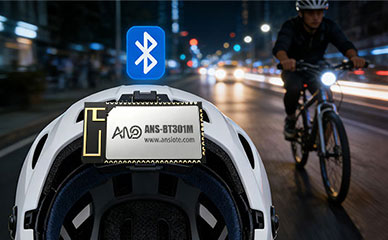
Met de bloeiende ontwikkeling van buitensporten en slim transport, slimme helmen zijn verschoven van de professionele fietsgemeenschap naar de massaconsumptiemarkt. Volgens branchestatistieken, de mondiale markt voor slimme helmen zal naar verwachting groter zijn dan dat $4 miljard door 2027, met een samengesteld jaarlijks groeipercentage dat groter is dan 15%. In het systeemontwerp van slimme helmen, de prestaties van de audiocommunicatiemodule bepalen rechtstreeks de levensduur van de batterij van het product, gesprekskwaliteit, en niveau van intelligentie. Dit artikel gaat dieper in op de toepassingsscenario’s van Ansiot Technology ANS-BT301M Bluetooth-audiomodule in slimme helmen: beheer met laag energieverbruik, handige communicatiecontrole, en AI-spraakinteractie – en bieden een complete hardwareverbindingsoplossing en praktische AT-opdrachtdemonstraties.
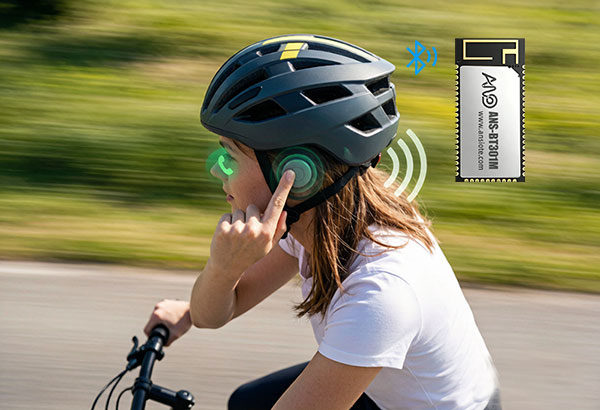
I. Slimme Bluetooth-oplossing voor helmen: Waarom een professionele Bluetooth-audiomodule nodig is?
Vergeleken met gewone Bluetooth-headsets voor consumenten, Slimme helmen worden geconfronteerd met strengere technische uitdagingen op het gebied van productontwerp:
- Knelpunt in de levensduur van de batterij - De batterijcapaciteit van een helm is doorgaans slechts 300-800 mAh, veel kleiner dan de batterij van een mobiele telefoon, waarvoor een strikte controle van het energieverbruik in de stand-bymodus vereist is;
- Interferentie door windruis — Bij rijsnelheden boven 60 km/u, windgeruis kan 90dB+ bereiken, stellen extreem hoge eisen aan de ruisonderdrukking van de microfoon en de gesprekskwaliteit;
- Operationele veiligheid — Beide handen moeten tijdens het rijden aan het stuur worden gehouden, en alle interacties moeten worden voltooid via spraak of een enkele knop, het elimineren van touchscreenbediening;
- Aanpassingsvermogen aan de omgeving — Stabiele werking is vereist in een temperatuurbereik van -10°C tot 50°C, hoge luchtvochtigheid, en trillingsomgevingen;
- Naleving van de regelgeving — Veel regio's hebben regelgeving ingevoerd die het bellen vanuit de hand tijdens het rijden verbiedt, waardoor handsfree beloplossingen voor helmen een compliance-noodzaak worden.
Algemeen gebruik Bluetooth-modules kunnen vaak niet tegelijkertijd aan alle bovenstaande eisen voldoen. De ANS-BT301M van Ansiot Technology is diep geoptimaliseerd voor slimme wearables en fietsscenario's, op maat gemaakt voor slimme helmen op het gebied van energiebeheer, ondersteuning voor audioprotocollen, en AT-commandocontrole.
II. Extreem laag energiebeheer: Slaap- en ontwaakmechanismen
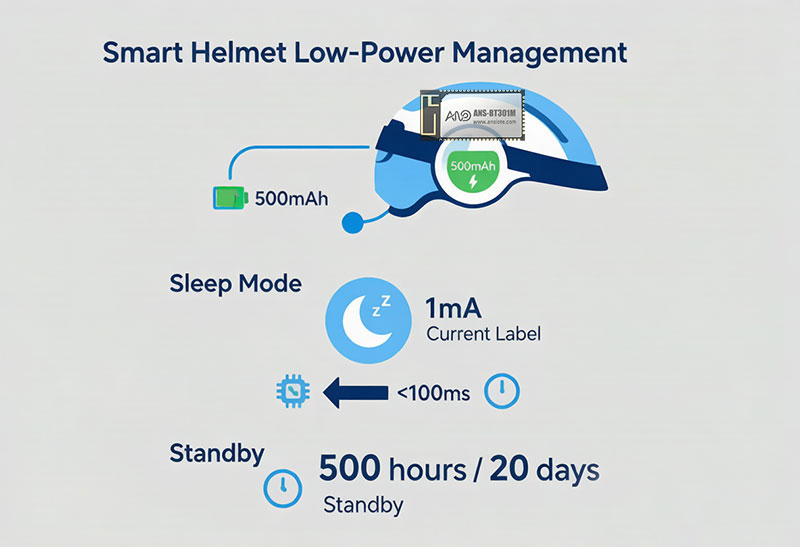
Slimme helmen worden doorgaans beperkt door de batterijcapaciteit en -grootte, en het stroomverbruik in stand-by heeft een directe invloed op de gebruikerservaring: helmen die regelmatig moeten worden opgeladen, zijn voor de markt moeilijk te accepteren. De ANS-BT301M biedt een flexibele energiebeheerstrategie, waardoor de levensduur van de batterij aanzienlijk wordt verlengd zonder dat dit ten koste gaat van het reactievermogen.
2.1 Slaapmodus: Statische stroom slechts 1mA
Wanneer de helm in de standby-modus staat (bijv., geparkeerd in een garage, niet gedragen door de gebruiker), de MCU stuurt via UART een slaapcommando naar de module:
- // MCU verzendt een slaapcommando
- AT+MODE=SLAAP
- // Modulereactie
- OK
De module gaat onmiddellijk naar een energiezuinige stand-bystatus, met een statische stroom van slechts ongeveer 1 mA. Gebaseerd op een typische lithiumbatterij van 500 mAh, de pure standby-levensduur van de batterij kan bereiken 500 uur (ongeveer 20 dagen), volledig voldoen aan gebruikers’ verwachtingen van “een halve maand gebruik met één oplaadbeurt.”
2.2 Ontwaakproces: Wakker worden met elk AT-commando
Wanneer een gebruiker de helm draagt en de audiofunctie moet gebruiken, de MCU hoeft alleen maar een AT-commando naar de module te sturen om deze uit de slaapmodus te halen.
Dit “on-demand wakker worden” ontwerp zorgt voor een snelle respons (wektijd < 100mevrouw) en gebalanceerd energieverbruik. Bij praktisch gebruik, het kan worden gecombineerd met de slijtagedetectiesensoren van de helm (zoals infrarood naderingsschakelaars of capacitieve sensoren) om geautomatiseerd energiebeheer te bereiken dat de helm wekt wanneer deze wordt gedragen en in de slaapstand zet wanneer deze wordt verwijderd.
III. Efficiënte communicatiecontrole: Met één knop beantwoorden en ophangen
Voor fietsers, vereenvoudigde bediening staat gelijk aan verbeterde veiligheid. De ANS-BT301M Bluetooth-audiomodule ondersteunt de standaard HFP (Handsfree profiel) protocol, maakt telefoonbediening mogelijk via eenvoudige seriële poortopdrachten zonder dat een telefoon met touchscreen nodig is.
3.1 Beantwoorden van inkomende oproepen
Wanneer de sensoren van de helm een inkomende oproep detecteren, of wanneer de gebruiker op een fysieke knop op de helm drukt, de MCU verzendt een antwoordcommando.
- AT+HFPANSW
- // De module maakt onmiddellijk verbinding met de oproep, en de audio wordt automatisch naar de helmluidspreker geleid.
3.2 Gesprekken ophangen
Wanneer het gesprek eindigt of de gebruiker het gesprek actief weigert, de MCU verzendt een ophangcommando.
- AT+HFPCHUP
- // De module beëindigt het huidige gesprek en keert terug naar de standby-modus.
IV. Slimme helm AI-spraakinteractie: Wake-up-oplossing voor Bluetooth-module
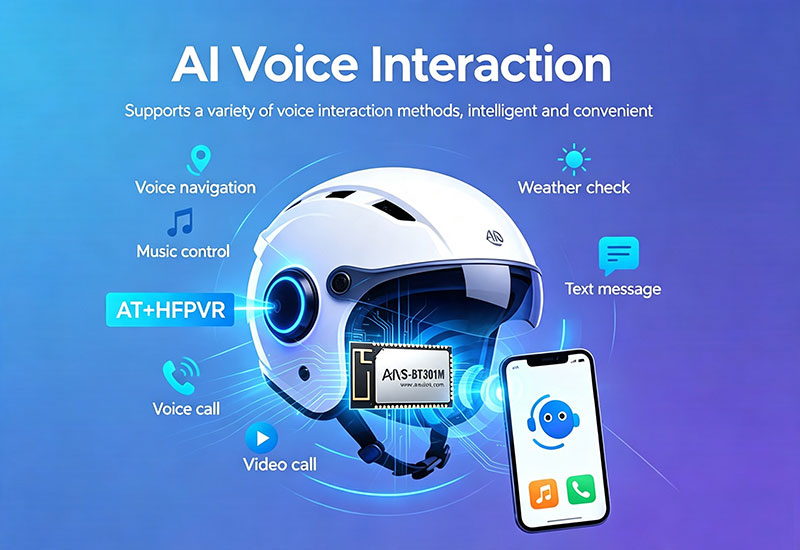
De kern van de “intelligentie-” van een slimme helm ligt in steminteractie. De ANS-BT301M kan fungeren als brug naar de AI-assistent van de telefoon, waardoor volledige stembediening mogelijk is: fietsers kunnen de navigatie voltooien, liedjes veranderen, controleer het weer, berichten verzenden, en meer met slechts één enkele zin.
4.1 Implementatie van Voice Wake-up-technologie
Door het HFP-spraakherkenningscommando te verzenden, de module activeert de spraakherkenningsfunctie op de mobiele telefoon.
- AT+HFPVR
- // De module stuurt via het HFP-protocol een stemherkenningsverzoek naar de telefoon
- // De AI-assistent van de telefoon (Siri/Xiao Ai/Google Assistent) is geactiveerd
- // De fietser spreekt een stemcommando uit via de helmmicrofoon
V. Hardwareverbinding en systeemarchitectuurontwerp
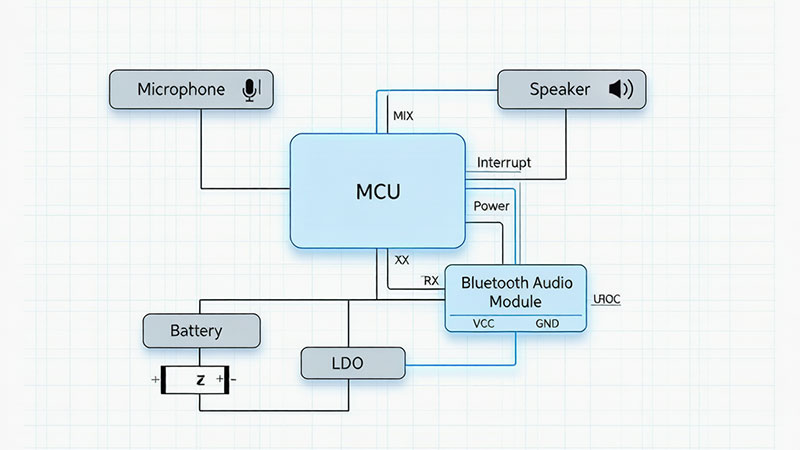
In het systeemontwerp van de slimme helm, de ANS-BT301M wordt doorgaans gebruikt als een slave-apparaat dat is aangesloten op de systeem-MCU. De algehele architectuur is helder en de bedrading is eenvoudig.
5.1 Communicatie-interface
AT-opdrachtinteractie wordt uitgevoerd via de seriële UART-poort. Alleen bedrading vereist 4 draden (TX, RX, VCC, GND). De standaard baudsnelheid is 115200, die kan worden geconfigureerd binnen het bereik van 9600 naar 921600 volgens projectvereisten.
5.2 Audio-invoer/uitvoer
- Microfoon — Een hoogwaardige directionele siliconenmicrofoon (signaal-ruisverhouding ≥ 60dB) wordt aanbevolen om een goede geluidsopname te garanderen, zelfs in winderige omstandigheden bij 80 km/u.
- Luidspreker — Een ultradunne helmspecifieke luidspreker van 32Ω of 16Ω wordt aanbevolen, balans tussen geluidskwaliteit en draagcomfort.
- Echo-onderdrukking — De ANS-BT301M heeft ingebouwde AEC (Akoestische echo-annulering), waardoor handsfree bellen van hoge kwaliteit mogelijk is zonder de noodzaak van een externe DSP.
5.3 Ontwerp van de voeding
Het wordt aanbevolen om een LDO-regelaar te gebruiken (zoals HT7133 of gelijkwaardig) om een stroomrimpeling te garanderen < 50mV voor schonere audio-uitvoer. TVS-diodes en ontkoppelcondensatoren zijn aan de ingangsklemmen toegevoegd om de ESD-bescherming en spanningsstabiliteit te verbeteren.
VI. Uitbreiding van toepassingsscenario's: Van fietsen tot volledige industriële dekking
De slimme helmoplossing ANS-BT301M is niet alleen geschikt voor fietsscenario's; zijn laag vermogen + audiocommunicatie + architectuur voor spraakinteractie kan een breed scala aan toepassingen bestrijken:
- Motor-/elektrische fietshelmen: woon-werkverkeer in de stad en lange afstanden, handsfree bellen + AI-spraaknavigatie;
- Helmen voor skiën/buitensporten – Stabiele werking in extreem koude omgevingen, muziek afspelen + team-intercom;
- Industriële veiligheidshelmen – Omgevingen met veel lawaai, zoals mijnen en bouwplaatsen, ruisonderdrukkende gesprekken + spraakverzendingsopdrachten;
- Brand- en reddingshelmen: communicatieondersteuning op ramplocaties, AI-stemondersteuning + commando op afstand;
- Slimme kinderhelmen: ouder-kindgesprekken + veiligheidspositionering spraakuitzending, Een laag stroomverbruik zorgt voor een batterijduur die de hele dag meegaat.
VII. Veelgestelde vragen
Hieronder volgen de meest gestelde vragen door ontwikkelaars en productmanagers bij het evalueren van de ANS-BT301M slimme helmoplossing:
Hoe laag kan het standby-stroomverbruik van de slimme helm zijn Bluetooth-module zijn?
De statische stroom van de ANS-BT301M in de slaapmodus bedraagt slechts ongeveer 1 mA. Gebaseerd op een typische lithiumbatterij van 500 mAh, de pure standby-levensduur van de batterij kan bereiken 500 uur (ongeveer 20 dagen). Gecombineerd met de slijtagedetectiesensor van de MCU om een automatisering te bereiken “wakker worden wanneer gedragen, slapen wanneer verwijderd” strategie, een enkele lading kan meer dan ondersteunen 15 dagen bij feitelijk dagelijks gebruik.
Hoe wordt het geluidsreductie-effect van de slimme helm gegarandeerd??
De ANS-BT301M heeft ingebouwde AEC (echo-annulering) en audiocodec-optimalisatie. Gecombineerd met de ingebouwde directionele siliconenmicrofoon en het DSP-ruisonderdrukkingsalgoritme van de helm, Zelfs bij winderige omstandigheden met een snelheid van 80 km/u kunnen heldere gesprekken nog steeds worden gegarandeerd. Aanbevelingen voor hardwareselectie: Gebruik een siliconenmicrofoon met een signaal-ruisverhouding ≥ 60dB. Voor de spreker, een 32Ω ultradunne helmspecifieke eenheid wordt aanbevolen. Houd audiobedrading uit de buurt van voedingen en hoogfrequente signalen; voeg indien nodig afscherming toe.
Welke interface gebruikt de ANS-BT301M om met de MCU te communiceren?
De ANS-BT301M communiceert met de systeem-MCU via een UART-seriële poort, ondersteuning van AT-commando-interactie. De standaard baudsnelheid is 115200, die kan worden geconfigureerd binnen het bereik van 9600 naar 921600 afhankelijk van de projectvereisten. Voor de bedrading zijn slechts vier draden nodig: TX, RX, VCC, en GND. Er zijn geen speciale vereisten voor het MCU-model; reguliere platforms zoals STM32, ESP32, en NRF52 kunnen direct worden geïntegreerd.
Hoe lang duurt de ontwikkelingscyclus voor een slimme helmoplossing??
Gebaseerd op de AT-opdrachtoplossing van de ANS-BT301M, technici die bekend zijn met embedded ontwikkeling kunnen doorgaans de integratie en het testen van audiofuncties voltooien 2-3 weken. Ansiot Technology biedt volledige ontwikkelingsdocumentatie, een AT-commandoreferentiehandleiding, voorbeeldcode, en één-op-één technische ondersteuning, waardoor de ontwikkelingscyclus verder wordt verkort. Het hele proces, van hardwareontwerp tot prototype-integratie, kan doorgaans binnen worden voltooid 4-6 weken.
Kan deze oplossing worden gebruikt voor elektrische fiets- of motorhelmen??
Absoluut. De ANS-BT301M werkt op 3,0V-4,2V, is compatibel met lithiumbatterijvoeding, en heeft een bedrijfstemperatuurbereik van -40°C tot 85°C. Het is geschikt voor de audiocommunicatiebehoeften van verschillende op het hoofd gemonteerde slimme apparaten, zoals motorhelmen, elektrische fietshelmen, skihelmen, en industriële veiligheidshelmen. Verschillende helmtypes vereisen alleen aanpassing van de montageposities van de microfoon en luidspreker; de Bluetooth-moduleoplossing is volledig universeel.
VIII. Samenvatting
De slimme helmoplossing op basis van de ANS-BT301M, door diepgaande integratie van kern-AT-opdrachten zoals AT+MODE=SLEEP, AT+HFPANSW/CHUP, en AT+HFPVR, lost perfect de pijnpunten van slimme helmen op in drie belangrijke dimensies: lange levensduur van de batterij, handige gesprekken, en steminteractie:
- Lange levensduur van de batterij — 1 mA slaapstroom, on-demand wakker worden, over 15 dagen standby-tijd met één keer opladen;
- Veilig bellen: beantwoorden/ophangen met één knop, handsfree rijden, conform en veilig;
- Spraakinteractie – Eén commando activeert de AI van de telefoon, waardoor volledige stembediening voor navigatie mogelijk is, selectie van nummers, en berichten, zonder dat er handen nodig zijn.
Deze oplossing vermindert niet alleen de ontwikkelingsproblemen, maar verbetert ook de concurrentiepositie op de markt van het eindproduct. Als u een slim helmproduct ontwikkelt of uw bestaande helmoplossing upgradet, Neem contact op met Ansiot Technology voor gratis monsters en volledige technische informatie voor de ANS-BT301M.