

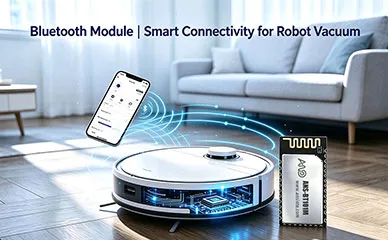
With the rapid development of smart home technology, robotic vacuum cleaners have increasingly become a standard household cleaning appliance. To enhance user experience and intelligence, a growing number of manufacturers are integrating wireless communication capabilities into these devices. Bluetooth technology, in particular, has emerged as an ideal choice for wireless control and data exchange, thanks to its low power consumption, low latency, and stable connection.
In robotic vacuum cleaners, Bluetooth technology is primarily utilized in the following areas:
1. Initial Pairing and Configuration
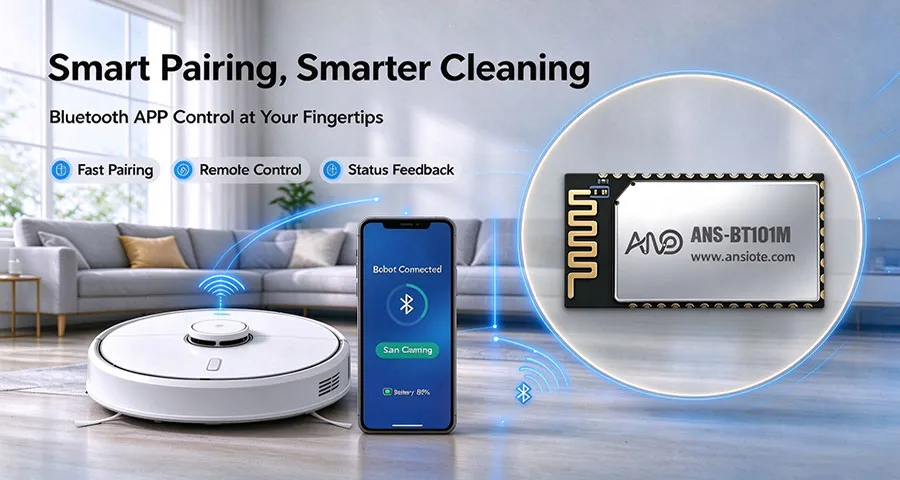
Users can quickly pair and configure their robotic vacuum cleaner via a mobile app using Bluetooth, without the need for a Wi-Fi network. This is particularly useful in scenarios where Wi-Fi access is inconvenient or for short-term use (예를 들어, in rental properties or homes of elderly users).
2. Local Remote Control and Function Settings
Bluetooth serves as a supplementary control method to Wi-Fi. In the event of a Wi-Fi disconnection or a weak signal, Bluetooth can be used to:
에이. Start/pause the device or send it back to its charging station.
B. Switch between cleaning modes (예를 들어, automatic, spot cleaning, edge cleaning).
C. Monitor device status and battery levels.
3. Firmware Upgrades, 유지, and Debugging
Developers or after-sales support personnel can connect to the device via Bluetooth to perform:
에이. 공중파 (오타) firmware upgrades.
B. Fault diagnosis and log uploads.
C. Parameter configuration and testing.
4. Multi-Device Interconnectivity (예를 들어, Docking with Base Stations)
In certain high-end models, the robotic vacuum cleaner must work in coordination with other equipment, such as automatic dust-collection base stations or floor-mopping units. Bluetooth enables short-range connectivity and data exchange between these devices.
Recommended 블루투스 모듈 Specifications (Using the ANS-BT101M as an example)
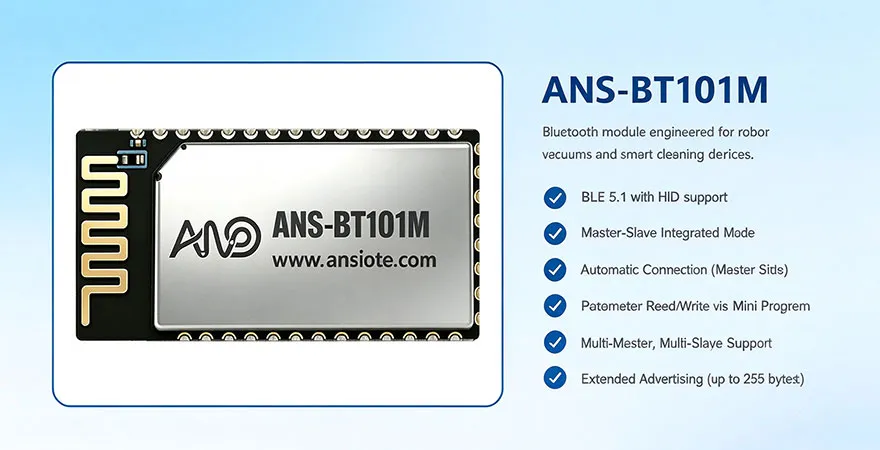
에이. Protocol Support: BLE 5.1, HID
B. RF Range: Communication distance of up to 50 미터 (depending on the environment).
C. 인터페이스: UART serial communication.
디. Supported Features: Transparent transmission, AT 명령, 오타, signal strength feedback, and multi-connection support.
E. 패키지: SMD (표면 실장 장치) 패키지, suitable for automated SMT (Surface Mount Technology) production.
F. Certifications: Supports various domestic and international certifications, including BQB, SRRC, and CE.
Reference Integration Method
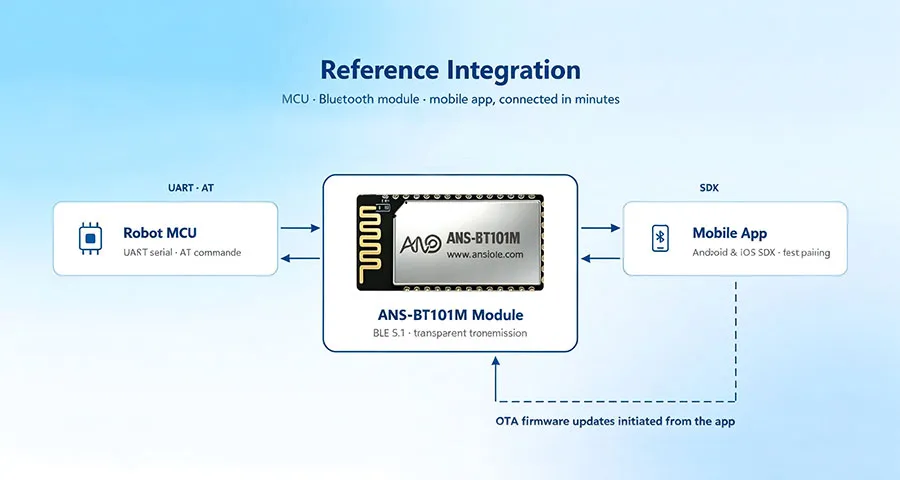
1. Connecting an MCU to the Bluetooth Module: The Bluetooth module is controlled via serial AT commands to facilitate communication.
2. App Integration with Bluetooth Devices: An SDK is provided—supporting both Android and iOS platforms—to enable rapid implementation of device connectivity and control.
3. 오타 (공중파) Upgrades: The OTA process can be initiated via the app, allowing the module to automatically download and install firmware updates for either the main controller or the module itself.
5. Application Case Study
A certain brand of robotic vacuum cleaner (developed in collaboration with partners such as Narwal, Dreame, or Roborock) utilizes a dual-mode 블루투스 + Wi-Fi control solution. During initial setup, the device connects quickly to a smartphone via Bluetooth; once Wi-Fi is configured, it transitions to remote control mode. In daily operation, Bluetooth serves as a supplementary control channel, ensuring a stable user experience. For after-sales support, Bluetooth facilitates remote maintenance, log retrieval, debugging, and firmware upgrades.
Bluetooth technology provides a convenient and stable near-field communication solution for robotic vacuum cleaners. It not only enhances user convenience but also reduces development and operational costs for manufacturers. As BLE (블루투스 저에너지) technology continues to evolve, its application in smart cleaning devices is set to become even more extensive and profound.