

Background
With continuous technological advancements and improved living standards, smart home devices are becoming increasingly common, with smart toilets becoming an important component in enhancing family quality of life. To further improve user experience, smart toilets and Bluetooth remote controls using Bluetooth technology are becoming a trend.
Solution Design:
1. System Architecture
The Bluetooth smart toilet system mainly consists of the following components:
Smart Toilet Body: Includes sensors, heating system, flushing system, and drying system.
Módulo Bluetooth: Built into the smart toilet, enabling wireless communication with the remote control.
Bluetooth Remote Control: A handheld device used to control various functions of the smart toilet.
Mobile Application (Optional): Connects to the smart toilet via Bluetooth for remote control and personalized settings.
2. Functional Design
The smart toilet and Bluetooth remote control should have the following functions:
Automatic Flushing: Automatically flushes after the user leaves, detected by sensors.
Heated Seat: Heates the seat according to user settings, providing a comfortable user experience.
Water Temperature Adjustment: Users can adjust the flushing water temperature via the remote control or mobile application.
Drying Function: Provides warm air drying, reducing paper towel usage.
Energy Saving Mode: Supports timed shutdown and low-power standby mode.
Personalized Settings: Users can save multiple user profiles for personalized use.
Solution Diagram:
Implementation Solution:
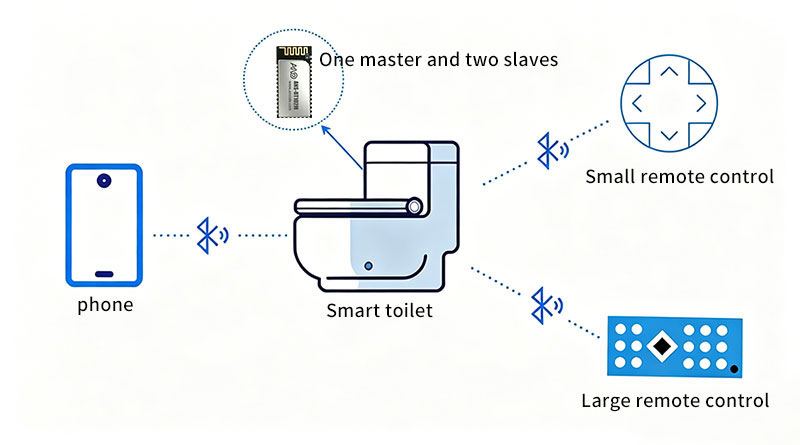
1. The smart toilet uses an ANS-BT102M low-power Bluetooth module, supporting one master and two slave functions, communicating with the toilet’s main controller via serial port.
2. The mobile phone acts as the master terminal, connecting to the ANS-BT102M smart toilet and controlling it via a mini-program or APP.
3. The remote control uses an ANS-MY3003 chip, supporting Bluetooth 5.2 for communication and control functions.
4. The ANS-BT102M smart toilet acts as the master terminal, connecting to two remote controls.
5. After receiving data, the ANS-BT102M smart toilet synchronously sends it to the mobile phone or remote control to maintain data synchronization.
6. By default, after the remote control wakes the device, it automatically enters sleep mode after 10 segundos sin datos.
Looking to the Future:
The design of the Bluetooth smart toilet and Bluetooth remote control solution fully leverages the advantages of modern Bluetooth technology, achieving a smart, convenient, and personalized user experience. Through reasonable hardware design and software development, this solution effectively enhances the user experience of the smart toilet, bringing users a higher quality of life.
En el futuro, with the further development of IoT technology, smart toilets can interconnect with other smart devices in the home, creating a more intelligent and personalized home environment. Por ejemplo, the smart toilet can be controlled via voice assistant, or more accurate health management suggestions can be provided through big data analysis. Bluetooth smart toilets will not only be home appliances but also likely become an important part of the smart home ecosystem.