 +86-18680305527
 sales@ansiotech.com

一. Background and Needs
With the development of urban shared mobility, smart mobility, and smart energy, electric bicycles, electric scooters, and public charging stations are becoming increasingly common. Traditional unlocking and activation methods mostly rely on mechanical keys, card swiping, or QR code scanning, but these methods have the following pain points:
1. Poor User Experience: Scanning QR codes or entering passwords involves multiple steps and long unlocking times.
2. Strong Network Dependence: QR code scanning requires a stable cellular or Wi-Fi network; the experience is poor in weak network environments.
3. Security Risks: Mechanical keys are easily copied, and QR codes may be maliciously replaced.
4. Complex Equipment Maintenance: Requires additional card readers or QR code scanning modules, resulting in high hardware and maintenance costs.
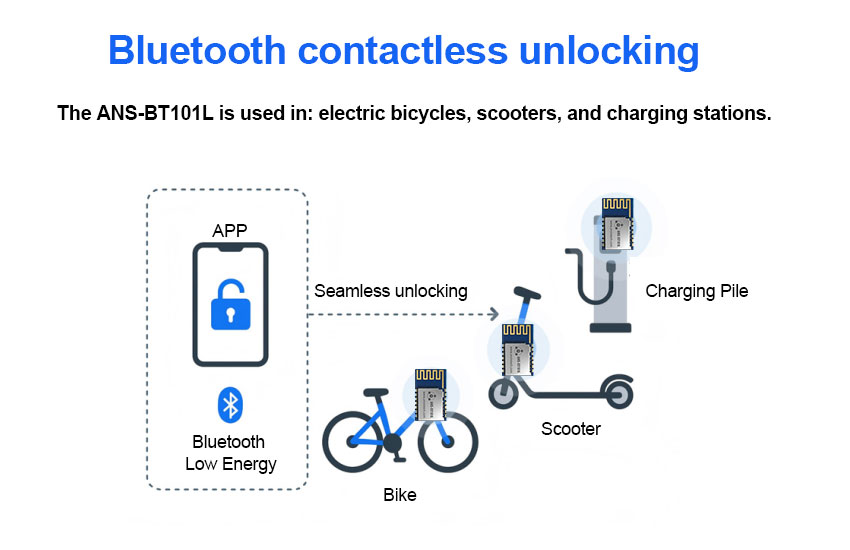
Seamless unlocking technology relies on Bluetooth BLE (Bluetooth Low Energy) and smartphone pairing, enabling a proximity-based unlocking experience, reducing operation steps, and improving security and convenience.
二. Technical Principles
1. Initial Binding:
The user registers an account in the app and completes the binding authorization with the electric vehicle/charging station’s Bluetooth module.
Bound information is encrypted and stored on both the device and the mobile phone, ensuring uniqueness and tamper-proof protection.
2. Seamless Identification and Verification:
When a user approaches the device with their bound mobile phone (usually within 5-10 meters), the Bluetooth module detects the paired device ID.
The device and the App perform two-way authentication (AES encryption + random number handshake) to ensure secure communication.
3. Unlock/Start:
After successful verification, the electric vehicle/scooter controller and charging station control module unlock or power on the device.
No manual operation is required throughout the process; it unlocks automatically upon approach.
三. Application Scenarios
1. Electric Bicycles
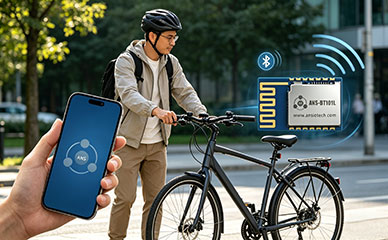
Personal Use: Users simply walk downstairs and approach their vehicle; the bicycle unlocks automatically, allowing them to ride immediately without needing to take out a key or open the App.
Shared Mobility: After booking a vehicle, users can ride it directly upon arrival, reducing pick-up time.
2. Electric Scooters
Community or Industrial Park Transportation: Residents or employees can unlock the scooter instantly by approaching it with their linked mobile phone.
Short-distance Travel: Improves convenience for frequent hop-on and hop-off trips, especially suitable for the delivery and takeout industries.
3. Public Charging Stations
Personalized Charging Stations: Upon returning to the garage, simply approach the charging station to automatically start charging, no QR code scanning required.
Shared Charging Stations in Residential Communities/Industries: The system matches user accounts based on mobile phone IDs and automatically calculates charging fees.
四. Solution Advantages
1. Ultimate Experience: No QR code scanning, no button presses, no waiting – truly instant unlocking or starting.
2. High Security: Based on Bluetooth Low Energy (بليه) + encrypted verification mechanism to prevent unauthorized connections and signal hijacking.
3. Low Power Consumption and Stability: Bluetooth BLE has extremely low power consumption, allowing for long standby times, suitable for extended operation of electric vehicles and charging stations.
4. Works with Weak Networks: Does not rely on real-time internet; can be used normally in underground garages and remote areas.
5. Easy Deployment and Maintenance: Only the Bluetooth module needs to be integrated into the device; no additional barcode/card scanning hardware is required.
五. Implementation Recommendations
1. Hardware Selection:
Choose an industrial-grade Bluetooth module that supports BLE 5.0 and above, such as the ANS-BT101L, compatible with iOS and Android devices;
The module must have AES encryption, low-power design, and fast wake-up capability.
2. Software Development:
The App must support background Bluetooth scanning and automatic connection to improve the seamless user experience;
Establish a binding management mechanism (unbindable and transferable), allowing binding in pairing mode, and preventing unlocking of unbound devices.
3. Security Strategy:
Encrypted transmission + dynamic key to prevent replay attacks;
Link the device’s unique ID to the user account.
After a bound mobile phone connects, it reports RSSI every second, in the format: \r\n+RSSI=1, mobile phone MAC address, signal value\r\n, used for MAC address and distance determination to unlock;
4. Operation Management:
Analyze usage frequency and location distribution by statistically analyzing device unlocking logs in the backend;
Provide users with a quick binding/unbinding entry point to improve usage flexibility.
The application of mobile phone-bound Bluetooth contactless unlocking technology in electric bicycles, electric scooters, and charging stations will greatly improve the travel and charging experience, reduce hardware costs and maintenance complexity, while ensuring security and ease of use. With the popularization of Bluetooth BLE technology and smartphones, this solution is expected to become the mainstream interaction method in the future fields of intelligent mobility and smart energy.