

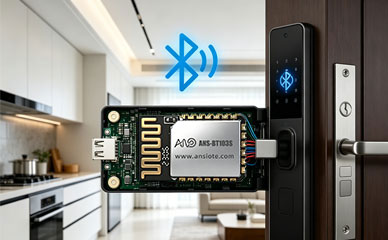
In the era of the Internet of Things (IoT), seamless, stable, and efficient wireless connectivity has become a core requirement for smart devices. From smart door locks to health bracelets, from industrial sensors to Bluetooth car keys—every IoT terminal needs a small, low-power, and easily integrated Bluetooth “heart.” Ansiot Technology proudly launches its new generation of low-power Bluetooth module, the ANS-BT103S, which integrates ultra-small size, BLE 5.2 master-slave functionality, serial port pass-through, and HID wireless backlink, bringing a breakthrough experience to wireless applications in smart homes, healthcare, and industrial electronics.
I. Industry Pain Points: Why a Smaller Bluetooth Low Energy Module is Needed?
In the BLE module selection process, hardware engineers often face the following major challenges:
Size Constraints—Wearable devices and portable medical instruments have extremely limited internal space, making it difficult to fit traditional 20mm+ modules;
High Power Consumption—Some modules have standby currents reaching several mA, severely reducing the battery life of battery-powered products;
Fixed Role—Many modules only support slave mode and cannot actively connect to other devices as a master, limiting system architecture flexibility;
High Development Barrier—Data transmission requires in-depth understanding of the Bluetooth protocol stack, with development cycles often reaching 2-3 months;
Poor Reconnection Experience—HID devices require manual pairing after each power outage, resulting in a fragmented user experience.
The ANS-BT103S was designed to solve these pain points—smaller, more power-efficient, easier to use, and more flexible.
II. In-depth Analysis of the Four Core Competencies of ANS-BT103S
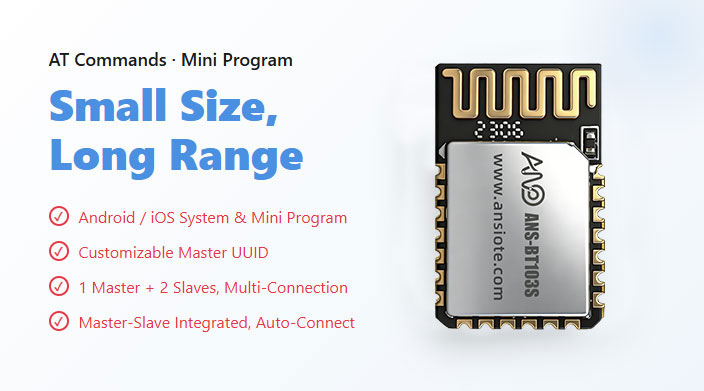
2.1 Extremely Small Size: 16×10×2mm Micro-packaging Technology
The ANS-BT103S adopts advanced micro-packaging technology, measuring only 16mm × 10mm × 2mm. It features a built-in PCB onboard antenna, eliminating the need for additional RF traces and external antenna design. It can be easily integrated into various applications, from the inner cavity of a smart bracelet strap, the compact casing of a portable pulse oximeter, to the sealed cavity of a miniature industrial sensor, providing unprecedented flexibility for product structure design.
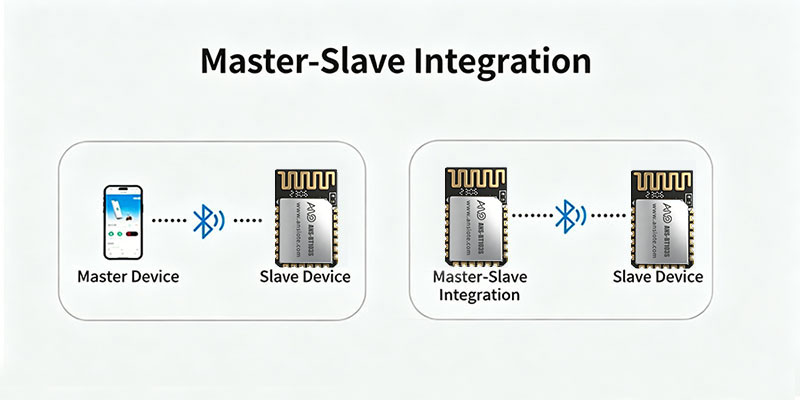
2.2 Master-Slave Integration: One Module, Two Roles
Say goodbye to single-mode limitations! The ANS-BT103S integrates master-slave functionality:
Master Mode (Central) — Acts as a central device, actively scanning and connecting to peripheral sensors, suitable for gateways, data acquisition devices, and other scenarios;
Slave Mode (Peripheral) — Acts as a terminal device, broadcasting and waiting for connections, suitable for sensors, smart locks, health devices, and other scenarios.
AT commands allow for one-click role switching, and modules from the same batch can adapt to different product requirements, significantly simplifying BOM management and reducing inventory pressure.
2.3 Serial Port Pass-through: Bluetooth Integration Now Barrier-Free
The ANS-BT103S uses a standard serial port pass-through protocol, making Bluetooth integration exceptionally simple. Developers don’t need to delve into the complex Bluetooth GATT/ATT protocol stack; they only need to send data through the MCU’s UART port, and the module automatically completes BLE link establishment, packet segmentation, retransmission, and verification—for the MCU, the Bluetooth module is simply a “wireless serial cable.”
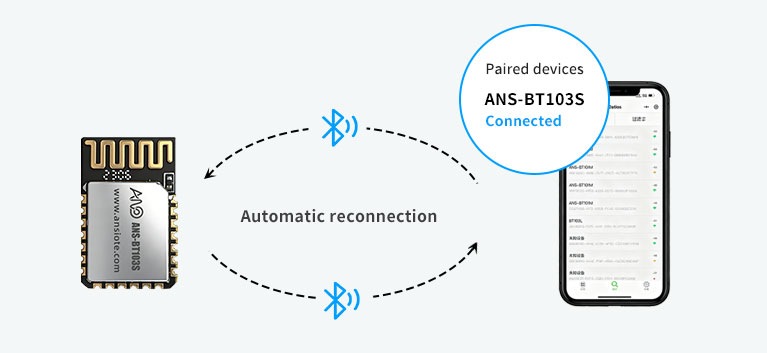
2.4 HID Wireless Backlink: Instant Reconnection After Power Loss
The unique HID wireless backlink function ensures that input devices such as keyboards, remote controls, and barcode scanners automatically reconnect to the host after power-on, eliminating the need for manual pairing by the user. This feature greatly improves end-user convenience, creating a truly seamless reconnection experience.
Typical applications: Bluetooth keyboards automatically reconnect after closing and reopening the cover; remote controls are ready to use immediately after a battery change; industrial barcode scanners can continue working without re-pairing after being turned off and restarted.
III. Complete Technical Specifications of the ANS-BT103S Low-Power Bluetooth Module
Bluetooth Version: BLE 5.2
Compatible Versions: BLE 5.0 / 4.2 / 4.0
Module Size: 16×10×2mm
Operating Voltage: 3.0V ~ 3.6V
Antenna Type: Built-in PCB Onboard Antenna
Communication Interface: UART (AT Commands)
Operating Temperature: -40°C ~ 85°C
Supported Functions: Pass-through / Master-Slave / HID
IV. In-depth Analysis of BLE5.2 Bluetooth Module Application Scenarios
The ANS-BT103S, with its small size, low power consumption, and flexible role switching capabilities, covers the following core application scenarios:
4.1 Industrial Data Transmission and Sensor Networks
In industrial settings, devices such as PLCs, temperature and humidity sensors, and pressure transmitters need to transmit collected data back to the central control system in real time. In master mode, the ANS-BT103S actively scans and connects to multiple sensor nodes, aggregating data to the gateway MCU via UART pass-through. This replaces the traditional RS485 wired wiring solution, saving over 60% in cable costs, and supports an industrial temperature range of -40°C to 85°C.
4.2 Healthcare Devices
Portable pulse oximeters, electronic thermometers, and heart rate chest straps have extremely demanding requirements for size and power consumption. The ANS-BT103S, with its 16×10mm dimensions, easily fits into a device housing. In BLE 5.2 low-power broadcast mode, its current consumption is only in the tens of µA range, allowing for months or even years of battery life when paired with a button battery.
4.3 Bluetooth Digital Car Keys
The ANS-BT103S master-slave Bluetooth module supports both BLE broadcast and connection modes, enabling a digital car key function that automatically unlocks the vehicle when the phone is near and automatically locks it when the phone is away. With automotive-grade safety certification (such as CCC 3.0), it can be applied to scenarios such as new energy vehicles, two-wheeled electric vehicles, and shared scooters.
4.4 HID Input Devices: Keyboard / Remote Control / Barcode Scanner
Utilizing HID wireless reconnection capabilities, the ANS-BT103S is ideal for input devices such as Bluetooth keyboards, remote controls, and industrial barcode scanners. It automatically reconnects within 1 second after a power outage and restart, requiring no manual user intervention and significantly improving ease of use. It supports compatibility with mainstream operating systems such as Windows, macOS, Android, and iOS.
V. FAQ
The following are the most frequently asked questions by developers and purchasing engineers when evaluating the ANS-BT103S:
What is the module size of the ANS-BT103S? Is it suitable for space-constrained devices?
The ANS-BT103S measures only 16mm × 10mm × 2mm and uses micro-packaging technology, making it one of the smallest BLE 5.2 modules currently on the market. With a built-in PCB onboard antenna, eliminating the need for an external antenna, it’s ideal for space-constrained applications such as wearable devices, portable medical instruments, and miniature sensors. The module is only 2mm thick, allowing for easy embedding into ultra-thin device housings.
How is the master-slave mode switched during actual development?
The ANS-BT103S switches between master and slave roles via AT commands, without requiring hardware replacement or firmware updates. Developers can freely switch between central and peripheral devices via UART commands. Modules from the same batch can flexibly adapt to different product requirements, significantly simplifying BOM management and reducing inventory pressure. Role switching response time is < 500ms.
What are the data transmission rates and latency in serial port pass-through mode?
The ANS-BT103S achieves an effective throughput of tens of Kbps in serial port pass-through mode, with a maximum single packet size of 244 bytes (after negotiated MTU). End-to-end latency is approximately 20-50ms (depending on connection interval configuration), meeting the data acquisition and control command transmission needs of most sensors. For scenarios with higher real-time requirements, latency can be further reduced by shortening the connection interval.
How can I obtain samples and development materials for the ANS-BT103S?
Ansiotech provides free sample testing services. Contact our sales team to apply for an evaluation kit: Email: sales@ansiote.com, Phone: 18680305527. We also provide a complete AT command manual, hardware design guide, reference schematics, and one-on-one technical support to help projects be implemented quickly.
VI. Summary
The ANS-BT103S is not just a Bluetooth module, but a key to the wireless upgrade of smart devices. With four core advantages, it is reshaping the industry standard for BLE modules:
Ultra-small size — 16×10×2mm, fitting into any compact space;
Master-slave integration — One module, dual roles, flexible switching via AT commands;
Serial port pass-through — Zero-barrier integration, development completed in one week;
HID reconnection — Reconnect instantly after power failure and restart, seamless reconnection experience.
Whether you are a startup or an established company, Ansiot Technology provides comprehensive support from module supply to complete solutions. The wireless future is here, and the ANS-BT103S helps you seize the opportunity!